Pages

Showing posts with label climbers. Show all posts

Monday, January 16, 2017

The Palash Tree Cafe at Native Place is now open

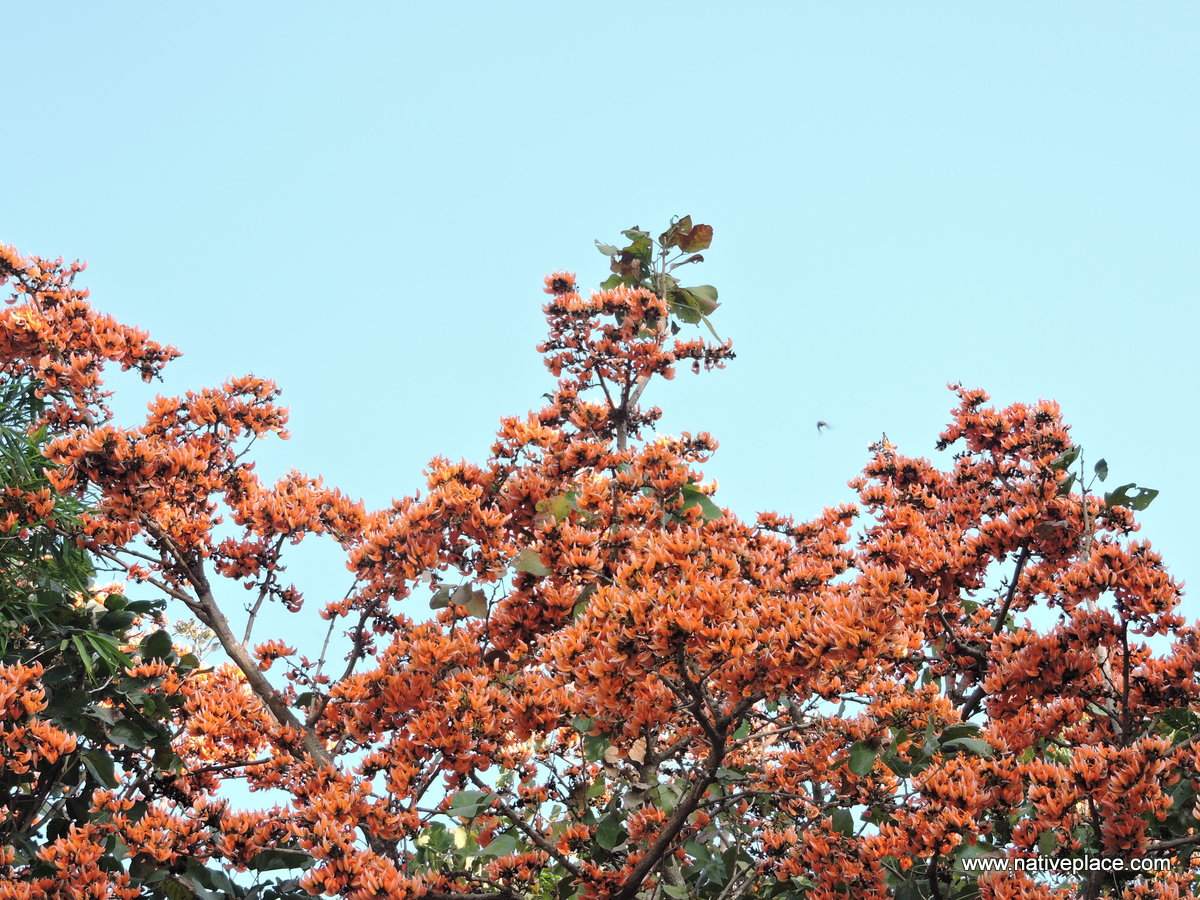
This year our  Palash tree has flowered in January – a curious thing because it usually flowers in March. Another significant thing for us is that it has flowered vigorously – the whole canopy is aflame with its blossoms making a striking picture. Is our late bloomer making up for its tardiness or is this also a result of global warming - one just isn't sure. 
Each day the flowers drop onto the steps that lead to the main door adorning them as though someone has painstakingly strewn flowers to welcome the Native Place  Guesthouse visitors  and Nirvana Paragliding students. . 
I went up to the terrace to get a better view and spotted a number of birds and squirrels attracted by the nectar full flowers. As i sat there i also smelt the Madhu Malati flowers and realized that the fragrance is quite strong in the early mornings.
Pasaba has started to use them in her floral urali decorations 
Coming back to the Palash tree – we are collecting the flowers to make a holi color – again this year. Did you know that the flowers were used to dye monks’ robes?  The flowers can also be  used to make a drink a herbal tea that helps one beat the heat.
For the next few weeks the terrace is going to be my morning go to place .  It is delightful to watch the soft early morning sun’s rays turn the canopy into a fiery orange thereby signalling the birds that the cafe is open. Cause soon after this the birds and squirrels arrive to feast on the sustaining morning beverage (nectar) their antics lead to the dropping of the flowers onto the steps. 
All this while i breathe in the crisp morning air scented by the beautiful flowers of the Madhu Malati vine 
Sheer bliss :) 
Astrid Rao 

Monday, December 8, 2014

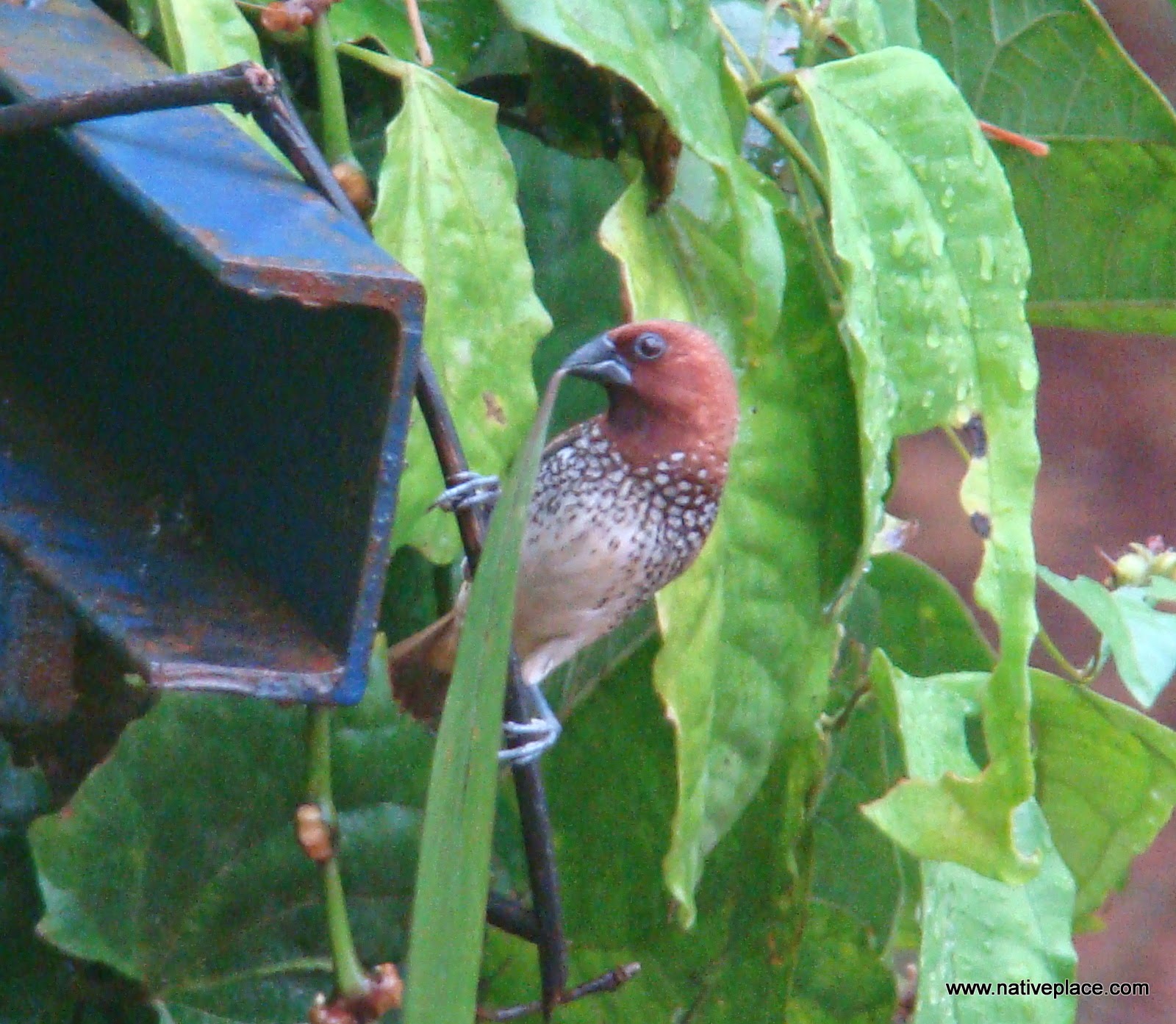
Scaly Breasted Munia at Native Place, Kamshet


Winter approaches and at Kamshet the paddy in the fields is ready for harvest. Driving through one can see people hard at work harvesting the grain. 

Last weekend I spotted a Scaly Breasted Munia in the garden from the veranda outside my room at Native Place  – Have only seen these birds once a few monsoons ago and was thrilled to spot  them so close to the house.  They were busy building a nest in the pergola outside the lake front rooms – this was easy to deduce as the birds were flying in and out with long grasses in their beaks and disappearing into the climber cover 

Here is some info on this little bird - The Scaly-breasted Munias breed year round and may have multiple broods on a good year, up to 3-4 broods. The male brings nesting materials while the female builds, often from the inside. In some, the breeding nest is later used as a roosting nest.

The nest is an untidy globe made out of grass and bamboo leaves, with a side entrance.  The nests are not woven and material is simply pushed together. But the nests are well-made, robust and waterproof. The birds work tirelessly and the nest can become an enormous globe. Both parents incubate. The eggs hatch in about 2 weeks and the young are fed entirely vegetable matter, which is regurgitated by the parents. They fledge in 18-19 days. Juveniles often form their own flocks after leaving their parents, and wander about together.  

Astrid Rao 

Monday, September 20, 2010

The Wasp Lady


Last Month at Native Place

A story you wont belive.

I was on the tandoor terrace in the morning leaning out and adjusting the fragrant Madhu-malati (Quisqualis Indica) vine that climbs up here.

I was so busy stretched out over the railing and pushing the vine back that I did not realize that I had upset a wasp’s nest just above. It was on the little parapet by the tandoor and as I pushed the stubborn branches to one side I shook this wonderful looking but very dangerous wasp’s nest.

Suddenly I began to hear a buzzing sound. It was not coming from nearby but from in my head I stepped backwards in front of the tandoor and put my head down whipping my hair forward. I put my hands in my sleep tousled and many days unbrushed tresses and began to do the don’t give a damn dance.

Daniel, Dwane , Michelle and Sanjay watched me for a while and then Daniel dashed forward – inserted his fingers into my knotted hair and began to comb them out one at a time – yes there were 12 of them all together , more than an inch sized wasps buzzing about in my hair.

One by one he snagged them out and they fell out to the ground got up and flew menacingly towards him – he dodged and kept at it and I kept doing the don’t give a damn dance and continued to mess with my hair. Above on the top terrace Apporva, Dylan, and some others stared over at me wondering what was going on.

By this time Daniel was telling me ‘they are gone they are gone’ and michelle was shouting ‘no no I can see them’ All the while I remained silent but continued to do the dance. ( dwane calls it the avatar dance)

Then Daniel got stung once and then again on the head. Now sanjay enters the fray with his slipper in hand – slippering my hair as I encourage him to go for it and not worry about hurting me.

Each time a wasp flies out of my hair I see him dodge it even with my head hanging down. Apporva and gang watch as Sanjay takes a chappal (slipper) to my hair.

Finally I pull the last one out but not before I get stung on the thumb. Mercifully with all that went down instead of multiple bites in the head face, legs, arms ( I was wearing shorts and a sleeveless tee) and they were buzzing around my face and body as they got out of my hair and flew about angrily before moving out.

Now Hiren who was earlier asking questions like what shampoo or conditioner I had used – comes back with a hairbrush to assist the operation.

It was all over by then – adrenalin was pumping full on and my thumb was swollen and throbbing

Sunith who was in the room all this while gets to hear that Daniel has been stung and immediately checks the EFR manual – he washes daniel’s forehead and makes him lie down, elevated his feet with a pillow and covered him with a blanket and sat to monitor his condition. He does not realize that I was stung too.

I look for the apis mel bottle ( homeopathic medicine for stings ) and find it has all but evaporated and the bottle is empty. So we used ice instead – as instructed by Sunith who also insists that I wash my hand.

Sunith then went online to try and identify the offending creature so as to decide what to do next !!!

The buzz in my head continued for a while – I kept imagining myself as the wasp lady – walking about with a big jumbled hairdo full of buzzing creatures – everyone was telling stories about each one’s reactions .

Serioulsly Daniel (one of my nephews) saved me from a swollen head and other complications

Happy to get off with just one sting

Astrid

Thursday, April 15, 2010

Mystery climber identified


The mystery climber I mentioned in a previous post continued to remain nameless for a while. This winter it flowered profusely drawing my attention each time I walked in or out of Native Place. I began to visit this climber every afternoon to watch the sun birds drink nectar from its hanging flower bracts. It continued to flower and show off up until the end of March inspiring me to keep the search on for its true name. Recently while browsing I hit pay dirt.

Thunbergia coccinea, Wall. (Hexacentris coccinea, Nees). A very tall climber: st. much branched, 4-angled: lvs. short-petiolate, variously shaped, the lower broadly ovate, with a hastate or cordate angled base, the upper ovate, cordate, all angularly toothed or the upper entire: fls. in terminal or axillary racemes, 1-3 ft. long; bracts large, inflated, as long as the tube; limb scarlet, of 5 reflexed emarginate lobes; throat orange. Autumn and winter. India.
Source: Standard Cyclopedia of Horticulture

Peace Bliss & Happy Landings

Astrid Rao

Wednesday, December 16, 2009


The Native Place garden is at its best right now with many types of climbers and shrubs flowering, lots of birds and butterflies too. Last weekend I spent Saturday morning wandering about the garden admiring my collection of climbers ( thunbergia mysorensis, t alba, t grandiflora, t mystery ( don’t yet know this one’s name ) clitoria ternate, honeysuckle, pyrostegia vanusta, Strongylon Macrobotrys, morning glory, and bridal bouquet clematis) and the many little birds fluttering amongst them. I felt such a wonderful sense of fulfillment seeing all those beautiful vines laden with flowers…. Little baby plants that I have tracked down, procured and cared for … now all grown up and bearing flowers … such a wonderful feeling it was and I was further rewarded with the spotting of a crimson sunbird – my first sighting of this bird ever.

Wednesday, March 18, 2009

An Ode to Salim Ali


The Jade vine creeper in the Native Place Garden has a new tenant. A female purplerumped Sunbird is busy building a nest in it. The female sunbirds are pretty dificult to identify compared to the males who have distinctive coloring. the females are all a olive brown above and whitish to yellow lower parts- Even with this picture on opening a birdbook i was puzzled on seeing 5 types of female sunbirds with similar colorings. But inveitibly Salim Ali comes to the rescue.

His discriptions of the sunbirds nests are so thorough
"an oblong pouch of soft grasses, rubbish and cobwebs, draped with pieces of bark, woody refuse and caterpillars' droppings, wit a projecting portico abouve lateral entrance hole. Suspended from the ti of a brnch of a bush or creeper at moderate heights, ofern adjacent to an occupied bunglow"
leaving me in no doubt whatsoever.

Years ago i used to see Salim Ali walking briskly along the seafront at Carter Road,Bandra. I had heard that he was very interesting to speak to. I never got the chance to listen to or walk with him but my experiences with his book 'The Book of Indian Birds' where he shares his rich experiences in such a beautiful manner makes me belive that he is still here guiding us birders.

Astrid Rao

Tuesday, November 4, 2008

Of flowering climbers


The jade vine is flowering once more and astonishing the guests at Native Place with its unusual color and stunning grace. The pepper vines are loaded with pepper and the mystery climber at the front entrance trellis also continues to flower, its hanging candelabra like bracts adding yet another shade of excitement to the Native Place Garden.

Butterflies are out in large numbers too floating about merrily sipping nectar from a variety of flowering plants we have grown especially to attract them.

This gardener has a lot to be happy about and grateful for. The sun, the rain, the flowers, the birds, the bees, and butterflies

Astrid Rao

Tuesday, August 19, 2008

Another Mystery Climber


A few weeks ago i noticed that the Thunbergia Grandiflora we had planted in May after much deliberation to grow over the trellis at the entrance to Native Place had some hanging bracts. These were a striking reddish pink in color and i wondered how they were going to transform into big mauve flowers which the climber is supposed to produce.

They finally opened to reveal small orange flowers. the entire effect of the crimson flower bracts and their precious contents is pretty striking and a pleasant surprise.


Welcome mystery climber. I have no clue as to the real name of this climber's is but I guess nature will share that secret with me in due time.

Astrid Rao

Sunday, February 10, 2008

Mystery Climber


After a few trips to the nursery looking for a Jacquemontia climber to replace the one that died out bore no fruit I decided to go with another nameless climber that we had in our garden nursery growing in a large bag. I had purchased it a few months ago and by now had forgotten its name but the leaves looked attractive and the plant seemed to be healthy so we planted it in place of the Jacquemontia

The climber grew well and had soon got to the Lake View Gallery level above the kitchen and over the little trellis there. The leaves were shiny green and very attractive but even a year down the line there was no sign of flowers. I delved through many books hoping to learn more about the plant including its name and flowering habits but came up with nothing.

When Swati and Suchitra visited us in May 06’ we spent many enjoyable evenings looking out at spectacular sunsets from this lovely Look Out Gallery. We often admired the mystery climber with its dense dark green ornamental foliage and wondered when it would flower. I began to joke that maybe it’s a male and was never going to flower.

Then by early June I noticed something that had to be a spray of buds. They took their own time opening keeping me guessing a little longer and finally revealed bell shaped rose magenta mildly scented flowers.

I was ecstatic. Bunches of gracefully arranged flowers stood out against the shiny green foliage looking pretty stunning. A long wait it had been but a fruitful one. With a clear visual of the flowers I was once more inspired to hunt down its name. Armed with a visual of the flowers in I surfed the net for a few days and finally I hit pay dirt. The mystery climber had a name after all.
Botanical Name: Saritaea magnifica,
Family: Bignoniaceae,
Other names: Glow vine, purple bignonia, saritaea
Origin: Colombia

The mystery was solved but the case shut for good about a year later when the plant died out!!!

Astrid Rao

Sky Blue Cluster Vine


In September 2004 we had planted Jacquemontia pentantha' also known as the Sky Blue Cluster vine in the box below the kitchen window to dress up a drab corner and cover up some ugly piping. Within a year this fast growing vine with its tiny bell- shaped ultramarine blue flowers had grown to reach the lake view gallery above and had gracefully framed the tranquil sky, lake and hill view of this lovely area.

We enjoyed its beautiful appearance and its gorgeous year round flowering for over a year and then the suddenly after the monsoon the plant died out.
I was saddened when the beautiful ultramarine blue flowering Jacquemontia died out. I had not taken into consideration that a perennial tropical climber could die in my tropical paradise. It was something of a shock when this happened. What was once a profusely flowering gorgeous looking area was now plain and bare.

This picture is a reminder of a beautiful climber that once was.

More about Jacquemontia: Originally from tropical America, this profusely flowering tiny blue flowered climber is easy to maintain. The stem of the creeper is slender and green and the leaves are arranged alternatively. The leaves are small, shiny and heart-shaped with pointed tips. The bell-shaped white-throated ultramarine blue flowers are produced in clusters at the ends for long stalks. The creeper looks gorgeous with its many flowers spread on it after rains and in the cooler season.

Jacquemontia pentantha bears flowers in all seasons. The growth is moderate and hence it looks neat. And if the creeper grows out of control, it can be easily and lightly trimmed. Flowers appear on new branches. Jacquemontia pentantha is propagated through seeds, cuttings and by layering. Remove dried stems to enable fresh growth.

It is attractive to bees, butterflies and birds. Being a hardy plant it does not demand too much attention. It grows in manured soil of any type. The plant needs moderate watering and requires full sun or partial shade. Given proper support, it can be easily grown on fences and balconies.

Sunday, February 3, 2008

Celebrating the first flowering of the Jade Vine at Native Place, Kamshet


The Emerald jade vine - Strongylodon Macrobotrys was sourced by Hari and planted by the pergola facing the lake in January 2006. We stumbled across it while searching for Mucuna Bennetti another grand tropical vine.

Once planted I imagined how it would look to have these foot and a half long huge hanging clusters bearing their bluish green claw shaped flowers hanging through the pergola roof.

Two years down the line it has consented to put on a show of flowers for us and to finally see it in bloom is a spectacular, amazing and most satisfying sight.

Native to the Philippines, the Jade Vine is a climbing plant that scrambles up though the tropical forest canopy to reach the light. Sadly, extensive deforestation has meant that this stunning plant is now threatened in its natural habitat, as vast swathes of the tropical forest are cleared for agriculture or felled for timber

Thunbergia Mysorensis – Clock vine


I first came across this plant while gardening online i.e. surfing through nurseries and info banks across the world. The flowers were spectacular. No wonder it was mentioned as one of the most popular vines in the world. Now with a name like Mysorensis I had a clue as to where to start looking for it in India.

I sent the link to my architect Suchitra Sholapurker who is based in Bangalore – we are in the habit of making wish lists of plants and especially climbers for different areas in the garden. She wrote back saying it was the very same climber she had described to me on a previous visit, but had been unaware of its name.

So come December 2006 she brought me 2 little plants from Mysore in south India. WE planted both of them by the pergola outside the 2 lake front rooms and hoped they would not steal the thunder of the wonderful Thunbergia Alba also growing here. They have been fussy growers and barely reached the top of the pergola after a lot of coaxing and care. Finally in a rare show of appreciation for all the tending and attention one plant flowered in the 2nd week of November bringing joy and gratitude to our hearts.

The Thunbergia Mysorensis is a vine originating from India. There are close to 100 species of Thunbergia in tropical Africa and India. Some are shrubs, some are vines. The flowers hang from the vine in clusters that can reach several feet Excellent for arbors or trained along roof supports where hanging clusters of spectacular flowers may be admired at eye level.

Astrid Rao