Pages

Showing posts with label kamshet. Show all posts

Wednesday, March 6, 2019

Yoga teacher and organic farmer Teruko Maehara from Japan visits Native Place.


Yoga instructor and practicing organic farmer from Hiroshima, Japan visited us in February.  She shares her experience:

My yoga friend Ivan Stanley from India told me Native Place was definitely a nice place to visit. Its India but not the India we imagine – people find India crowded, chaotic and noisy but that is the city – this place is a tranquil space. 

Being close to Pune – Iyengar centre she found it convenient and practical to visit the Iyengar Yoga Center in crowded Pune and return to the peaceful atmosphere at Native Place
Its good for permaculture, meditation and yoga.  Local food, garden veggies good for yogis.  One can also have a paragliding experience


My travel -  I took a plane to Delhi and a domestic flight to Pune. The guesthouse organised a taxi to pick me up from Pune airport – one hour’s drive. So, it was all very convenient. Not difficult at all for a single traveller.

I hour from the crowded city of Pune Native Place is a fresh oasis of green. Filled with many beautiful native trees and lots flowers, birds and overlooking has lots of greenery. It is dry and brown outside but a fresh green oasis here.


What to do here - If you wish farming, cooking, paragliding, swim in the lake, enjoy the sunset by the lake or from the terrace, join a workshop is one is going on. There are many hidden places to spend quiet time and be alone. To read a book or meditate when you need Or enjoy conversations with other guests from all over the world and local people . The air is fresh and unpolluted, there is lots of place for kids to play so it’s good for families as well.

Most can speak English, so it makes it easy to converse with guests and staff.  I would think / recommend it as a good place to escape the winter for people from Europe and Japan. I came end of January and it was sunny in the day time, dry weather, I could walk barefoot. In the evenings and early morning its cool and fresh.


 I found people visiting the Native place to be like a family – Saturday night reunion of paragliding pilots and friends, a community atmosphere, chill out, catch up with each other.  It’s definitely a  nice place to meet people as well.


I’m really happy I came and spent a quiet week here – my next stop is the Vipassana center in New Bombay after which I travel back home to winter in Japan.


Wednesday, January 18, 2017

Native Place Off Site


Last week we had a young energetic group of people from the IT field visit the Native Place guesthouse for a weekend of team adventure, bonding, fun and relaxation. House of Code comprised a 45 strong group.

Zip Line Demo 

All Smiles on the Zip Line 

Low Ropes Course Team Building Activity 

They arrived mid morning to be led through the zip line, valley crossing, and the low ropes course by the Nirvana Adventure Crew. The day flew by with a small break for lunch – Led by the Nirvana Adventure Crew, the participants got into the mood and enjoyed each activity.

By the evening they gathered around the bonfire and entertained themselves with a bunch of fun party games, and BBQ followed with dinner.


Panoramic Views from the hill top 
The next morning there was a trek to the hills above to spend some time in the wilderness and enjoy a panoramic view from above.  They returned lounged around in garden and departed after lunch happy and rejuvenated.

Native Place offers corporate groups a range of  adventure and nature activities to choose from
Click here for more details


Astrid Rao
www.nativeplace.com
www.flynirvana.com


Monday, January 16, 2017

The Palash Tree Cafe at Native Place is now open

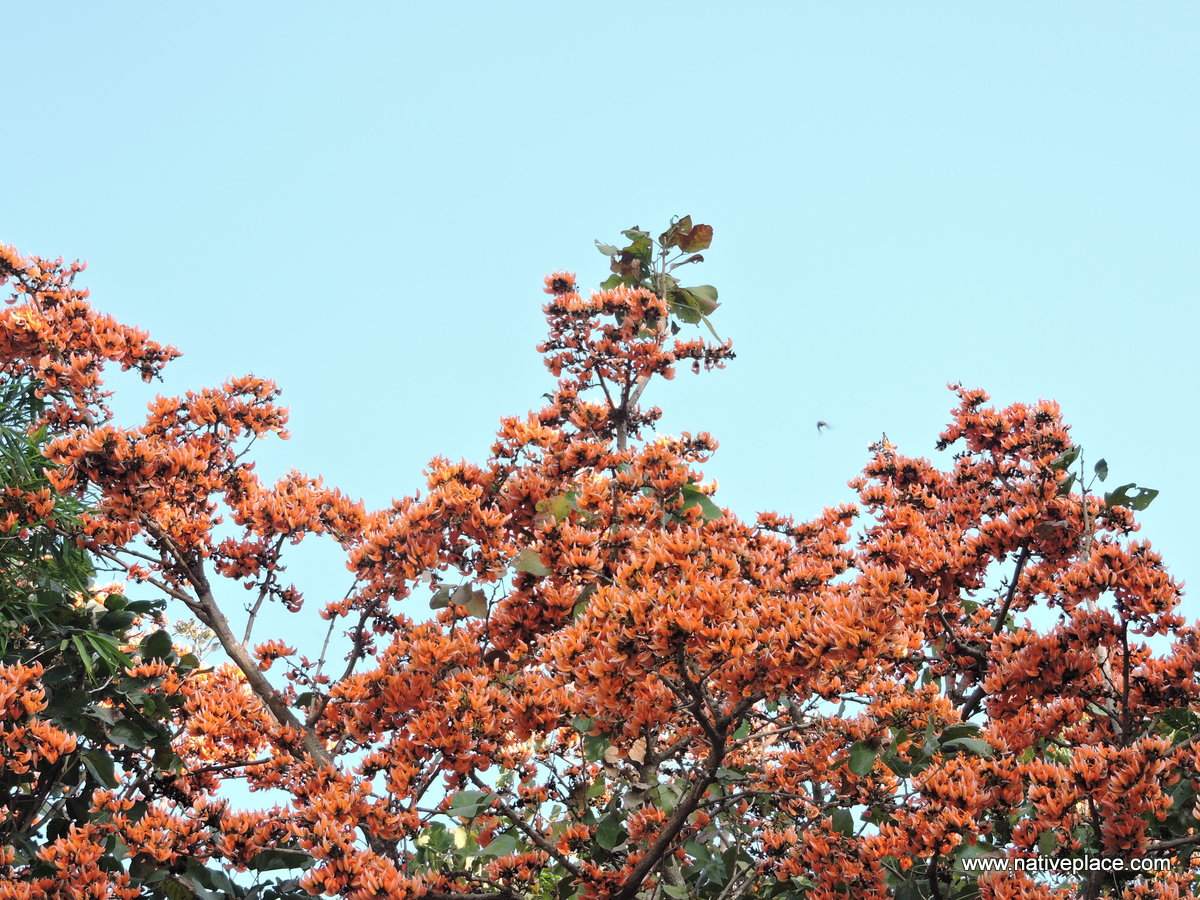
This year our  Palash tree has flowered in January – a curious thing because it usually flowers in March. Another significant thing for us is that it has flowered vigorously – the whole canopy is aflame with its blossoms making a striking picture. Is our late bloomer making up for its tardiness or is this also a result of global warming - one just isn't sure. 
Each day the flowers drop onto the steps that lead to the main door adorning them as though someone has painstakingly strewn flowers to welcome the Native Place  Guesthouse visitors  and Nirvana Paragliding students. . 
I went up to the terrace to get a better view and spotted a number of birds and squirrels attracted by the nectar full flowers. As i sat there i also smelt the Madhu Malati flowers and realized that the fragrance is quite strong in the early mornings.
Pasaba has started to use them in her floral urali decorations 
Coming back to the Palash tree – we are collecting the flowers to make a holi color – again this year. Did you know that the flowers were used to dye monks’ robes?  The flowers can also be  used to make a drink a herbal tea that helps one beat the heat.
For the next few weeks the terrace is going to be my morning go to place .  It is delightful to watch the soft early morning sun’s rays turn the canopy into a fiery orange thereby signalling the birds that the cafe is open. Cause soon after this the birds and squirrels arrive to feast on the sustaining morning beverage (nectar) their antics lead to the dropping of the flowers onto the steps. 
All this while i breathe in the crisp morning air scented by the beautiful flowers of the Madhu Malati vine 
Sheer bliss :) 
Astrid Rao 

Saturday, July 2, 2016

Palikade Permaculture Project – Water Harvesting & Soil Conservation (WH & SC)


 The Native Place guesthouse and garden is a labor of love that we have tended to since early 2000.  Today the garden comprises a delightfully diverse group of flora and fauna. a paradise for tree lovers and birders and everyone who loves  nature and gardening. It is exactly what we had envisioned it to be and more but being just an acre and a half in area we soon ran out of place to accommodate the plant palette (our wish list of trees).  Palikade, (an 18-acre plot of land in Thoran Village) that we acquired for this express purpose, is where we intend to manifest this dream. The vision is to develop Palikade as a self-sustaining farm & tropical food forest aimed at facilitating harmony amongst all stakeholders in the habitat (the birds, insects, microorganisms and other animals as well as us humans).

We were aware that it was very important to work on Water Harvesting & Soil Conservation (WH & SC) structures as a priority before planting trees on a large scale. These are also called ‘landforms’.  The land at ‘Palikade’ comprises two fairly flat areas of land divided by a huge gully running in between. The slopes and high rainfall combination in this region meant that significant soil and water was running off the land every monsoon. Also, rain is the only source of water on this land, so, the sooner we undertook the work on landforms, the lesser would be the loss of precious soil and greater the gains of water retention.

The Permaculture Design Course (PDC) that we attended in March 2016 gave us significant confidence with respect to the understanding of WH & SC. We undertook practical work at the PDC, designing and creating WH & SC structures like contour trenches, percolation tank, gully plugs and brushwood. Our two gardeners at Native Place, Anil & Eknath, attended two days of Water Harvesting sessions at the PDC and  thankfully they too learnt the basics and were able to support us in this effort.

Our journey of implementation started with inviting Narsanna to Palikade when he gave us some crucial inputs regarding WH & SC work. Thereafter, we invited Osman Baig, a watershed expert who we met during the PDC, to guide us with the location for different WH & SC structures. Osmanji, came in April for two days and helped us mark the area for a percolation tank, a pond, trenches & bunds and some gully plugs. We asked him plenty of questions so that we understood the logic of all his inputs.

Thereafter, we got down to detailed marking of all the structures on the land. We then did rough measurements around the entire land & drew out the plan and designs on paper. This helped us get greater clarity of the overall picture. The next step was actually making these structures with the help of a JCB and manual labor.

We also figured the details from local sources that annual rainfall in this area was about 2,500mm, number of rainy days was 82 and the highest rainfall in 24 hours was 176 mm. This helped us decide factors like the depth of the trenches to be dug and the distance at which contour trenches needed to be dug.

Some details about the structures are provided along with the individual pictures in this album. Need to specially mention here about the Percolation tank (PT) and pond. Part of this property (about 1 acre) is on the other side of a road, towards the South. It has high slope. At the bottom of this sub-plot, there is the possibility of accumulating water from a catchment of about 7 hectares. Hence a PT was created right there. The water that is likely to accumulate there is being routed to another pond on the farm, through a pipe running across & under the road. 

On his subsequent visit, Osmanji also identified the scope to route more water to the pond by creating a rainwater diversion trench. He also suggested developing a micro-pond in the Western side of the plot – this area was quite rocky and was sloping towards a small gully, which further met the main gully.

By end of May, we had completed all the landforms work. The structures we created have the capacity of holding about 34 lac liters of water at one time.

Structures
Capacity - Volume
About 1,200 running metres of deep trenches and bunds
1200 m3
12 lac litres
Percolation tank
350 m3
  3.5 lac litres
Pond
1700 m3
17 lac litres
Micro pond
100 m3
  1 lac litres
Staggered trench
14 m3
14,000 litres
Capacity / Volume(approx.)
3,407m3
33.64 lac litres

Simultaneously, in April & May, we were working on designing the plantation on these WH & SC structures, collecting seeds directly from trees & from friends & networks, growing saplings in our own nursery at the Native Place guesthouse & also scouting nurseries for plants that we were not growing ourselves. By second week of June, we were all equipped to start planting - the story of which you may have read in our previous post regarding the plantation J


This has been the first phase of WH & SC and plantation. We intend to take this forward step by step and attempt more intricate permaculture applications. The aim is to conserve & impound rainwater, raise aquifer levels, enhance soil health, create micro climates and an abundant habitat!

We’ve never felt we had completed anything very significant until now. But the amount of inquiries we received from our farmer friends for a detailed account of the work pushed us to do this write up. Feeling humbled & grateful.

In Solidarity,


Friday, July 1, 2016

The Palikade Permaculture Project – Phase 1 plantation


In March 2016, we (Astrid Rao and Sneha Shetty) attended a Permaculture Design Course (PDC) organised by Academy for Earth Sustainability and conducted by Narsanna Koppula , where we were introduced to the intricacies of water harvesting and soil conservation (WH & SC) among many other themes of permaculture.


In WH & SC, we learnt about “vegetative consolidation” of water harvesting structures i.e. consciously designed multi-level planting of trees, shrubs and ground cover on the water harvesting structures. The purpose is to strengthen the structures, increase biomass, enhance soil health, create micro-climates and many others. The loose soil of the newly created bunds also provide a good base for new saplings to grow in.

At our 18-acre farm in Kamshet, which we call ‘Palikade’, we decided to start with designing the land forms for WH & SC. We have only the rains as a source of water here, so we decided to grow indigenous/ native, hardy, rain fed trees as well as quick growing leguminous shrubs that would fix nitrogen into the soil, provide us loads of biomass and create microclimate. We started growing saplings of the latter in our nursery in April. Then we made a plant palette of what would grow well in our area, choosing species that would serve many functions. It would be a tropical food forest that would provide for food, clothing, shelter and other needs of not just the human residents but all the stake holders including the birds, insects and micro organisms (in Narsanna’s words). This was a great opportunity to grow native trees that have been on my wish list for years (yes, i am a serious tree lover).


We began the water harvesting structures in April - boundary trenches, contour trenches, a couple of ponds and a percolation tank at the highest point in the property with the hope that they will hold the water and let it percolate into the subsoil, thereby using the soil itself to hold water. We also intend to grow a mix of cereals, millets, pulses, oilseeds and green manure on the land meant for growing annual crops & orchards in future. This is to regenerate the soil (‘make the entire land a compost pit’ – Narsanna’s words). In the coming months, we will continue to plant a live fence on the boundary, comprising of various plants serving multiple functions.
Permaculture has the answers people – and Narsanna Koppula (founder of Aranya Agricultural Alternatives, Hyderabad) is a leading light of our times.

In the last one week, we have planted more than 2200 saplings and cuttings (of about 90 species), sowed hundreds of seeds and will continue to populate the bunds with ground cover (grasses, climbers and shrubs) of various types that will all do their bit to contribute to the fertility of soil and up our sustainability quotient.

Wishing you a very Happy Van Mahotsav – we at Native Place and Nirvana Adventures are happy to contribute to the mammoth task that the Maharashtra govt has undertaken to plant 2 crore trees by the 1st of July 2016. We are grateful that we could source about 1,000 plants from Government nurseries (Forest Dept- Shirota, Social Forestry - Pune & PWD- Pune) at very affordable rates. Thanks a ton, guys!

Peace Bliss & Happy Landings
Astrid Rao & Sneha Shetty
From Native Place and team & Nirvana Adventures  , Kamshet , India
www.nirvanaadventures.com
www.nativeplace.com
Plantation Photo Album: https://www.facebook.com/147992775230428/photos/?tab=album&album_id=1333965536633140

Monday, June 13, 2016

Which Kadamba Tree ?

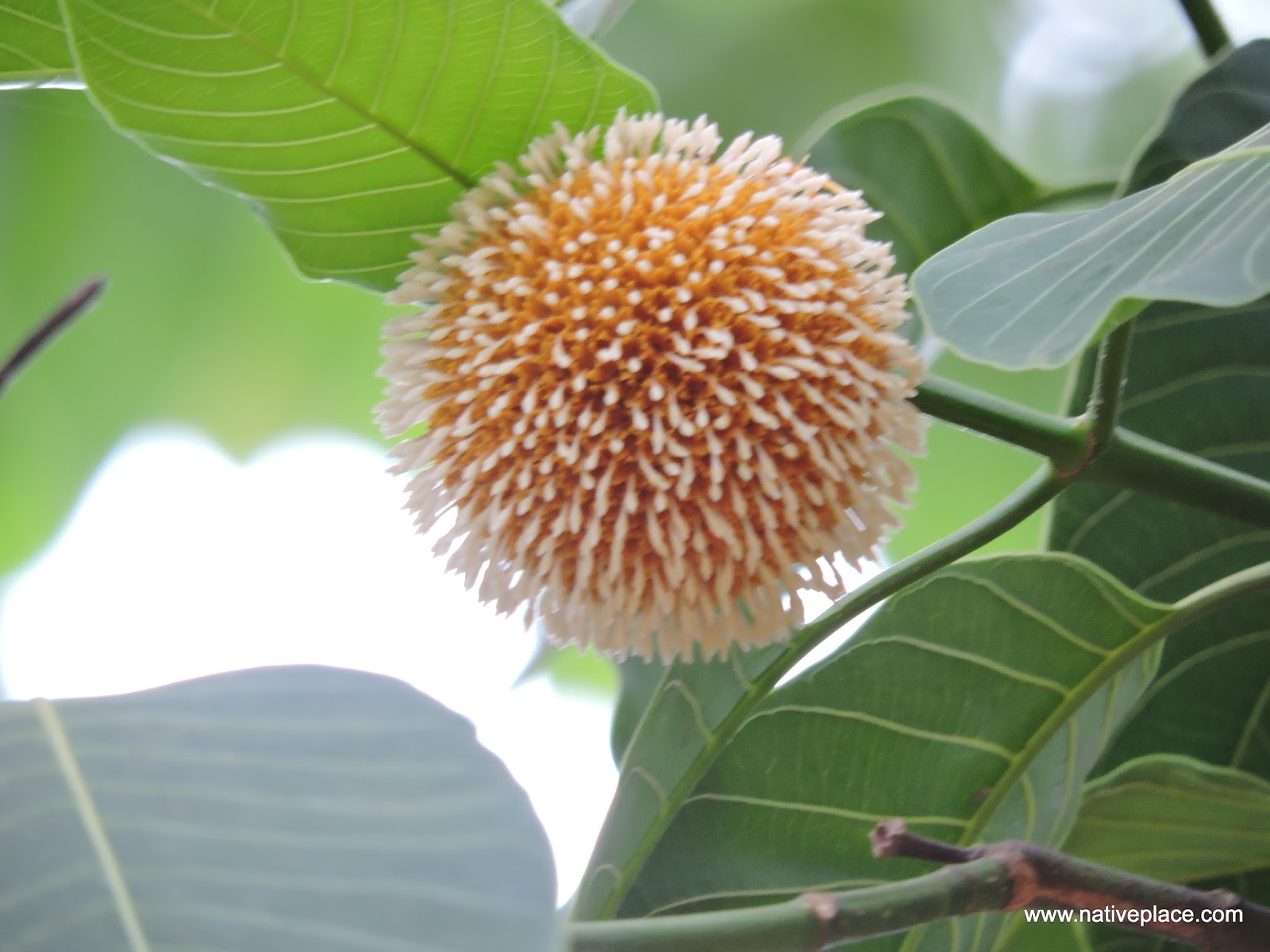
Kadamb (Anthocephalus Cadamba/कदंब) or The Common Bur Flower is a large, handsome, umbrella shaped tree with branches arranged in whorls around the central trunk. It is evergreen, fast growing and has a graceful appearance.  It produces unique globular shaped flowers coloured a striking yellow to orange.  
 In India the tree is mainly associated with Lord Krishna and stories about him and his gopis prancing about in the forests of Brindavan among the Kadamba groves abound.  This tree is also closely associated with the Mother Goddess (often referred as Kadambavana vasini) "She Who Resides in the Forest of Kadamba Trees."

We have a lovely specimen of this legendary tree in the Native Place Garden that we planted about 7 or 8 years ago having been intrigued by the lore of its beauty as well as its mythological and ecological associations.  You can enjoy its beauty and shade throughout the year but in the month of May the tree offers a special sensory experience when it flowers in profusion, showing off its quaint yet beautiful flowers that attract a host of bees and exude a heady perfume. And as the flowers drop one finds the curious golden globes scattered all around the tree waiting to dry off and release thousands of little seeds.

We have built a low wall all around our Kadamba tree. A silent invitation to you to come sit under this tree and enjoy the ambience it conjures.

The Kadamba Anthocephalus Cadamba  is often mixed up with the Kaim – Mitragaayne parviflora  a tree that is dominant in the forests of Brindavan. Both spcies produce globular blossoms but the Kaim’s flowers are not as striking  to look at. They also differ greatly in canopy and leaf shape. Where the Kadamba has a straight bole and branches arranged in upward reaching whorls the Kaim has a fairly meandering trunk.

i came across the Kaim in the “Trees of Delhi” by Pradeep Kishen. Pradeep  sheds light on this confusion/ puzzle on page 149 –  where he informs us that the REAL Krishna Kadamb  of Brindavan is Neelamarcia  cadamba ‘Kaim’ not Anthocephalus Cadamba ‘Kadamba’  which  is unique to moist  forests in the NE of  India and would not survive unaided in the hot dry  Brindavan area.  Kaim on the other hand is not only native to the remnant Brindavan forests but is their dominant tree. But in the Brindavan region the Kaim is called kadamb  J  no wonder the confusion !

Oh well !!! Our Kadamba may not bring to mind the visual of Krishna playing his flute any more but it remains the tree closely associated with the Mother Goddess  - Kadambavana vasini "She Who Resides in the grove of Kadamba Trees."
The tree is said to be vanishing from Indian forests and needs to be planted and celebrated once more for it its beauty, functionality and usefulness.
Some Uses
This beautiful tree is also known for its medicinal virtues. The tree has astringent & antipyretic properties. It is believed to have cure for ulcers, digestive ailments, diarrhoea, expectorant, fever, vomiting etc.

A yellow dye is obtained from the root bark. Kadamb flowers are an important raw material in the production of attar, Indian perfume with Sandalwood (Santalum Album). The tree is grown along avenues, roadsides and villages for shade. The fresh leaves are sometimes used as plates.


In Permaculture
The Kadamba is suitable for reforestation programs. It sheds large amounts of leaf and non-leaf litter which on decomposition improves  the  physical and chemical properties of soil.

Cultural aspects
It is common belief among the natives of many villages in the state Chhattisgarh that plantation of Kadamb tree near to lakes and ponds, brings happiness and prosperity in their life.


Thursday, January 21, 2016

5 Star Bird Watching in the Native Place Garden

  
 Doc was here on his annual visit. He has been spending the month of December with us (Native Place Nirvana Adventures) for almost a decade now to indulge in Paragliding his main obsession along with swimming, bird watching, gardening and this time cycling too.


This year things were a bit different. Doc said he had gotten over his paragliding obsession and although flying remains high on his list he often took time out now and then to indulge in the art of doing nothing.

One day i came across him sprawled in a hammock in a shady isolated spot in the garden. He had a book and his binoculars handy and when I approached him he mentioned to me that he was indulging in 5 Star bird-watching. It’s simply perfect he said – all afternoon I relax here reading and every now and then a bird comes by and as I sit here watching the birds present themselves and I don’t even have to move to see them from different angles to recognize or admire them.

Doc has been a birder for many years and i often go to him if I am not able to recognize a new visitor. We discussed the variety of birds that visit the garden – thanks to the biodiversity that we have created over the past years. Birds are indicators and their presence tells us that we have done a good job.

Check out the album of just some of them that we have clicked over the years.
Happy Birding and Hammocking in the Native Place Garden


Astrid Rao 


www.flynirvana.com

Friday, June 5, 2015

The Firefly Phenomena in the Native Place Garden

It happens in the transition of seasons, when summer is on its last legs and the SW monsoon winds begin to penetrate inland signaling the beginning of the monsoons season.  Every night starting at the end of May the Native place garden comes alive, lit up by magical fairy lights. It begins with a single spotting, a few days later a few more and soon the numbers increase until they reach an amazing intensity by the time the monsoon arrives.

Even in the light of the waxing moon these fairy like creatures are mesmerizing to look at.  Fireflies can be seen all over the garden lighting up shrubs, hedges and tree canopies but they do seem to have preferences for certain flora.

Look out from the Native Place  terrace into the canopy of the little Ain tree to see smatterings of ephemeral lights gliding about, floating up and sinking down like graceful glowing embers from a bonfire.  The whole tree seems alive with the many random, slow, fluid movements and lighting rhythms. Watching these guys for a while brings on a sense of awe and quiets the mind. 

Another Ain tree a little further away has another vibe going on altogether. Here we see lots more fireflies going off in a pulsating synchronized  fashion  sweeping up from the bottom or the top or even initiating spontaneously from the middle of the tree canopy. Sitting on the steps looking up at this insignificant by day tree one can’t help but feel lucky to be here right now witnessing the energy that dwells in it.


 My fancies are fireflies, specks of living light twinkling in the dark.

Tagore

When was the last time you saw fireflies?

For many of us who have been born and raised in the city, fireflies may have well been the subject of fairytales and myths. But you too can have this special experience by simply booking a night’s stay at the Native Place guesthouse at Kamshet (3 hours from Mumbai and one hour from Pune

Come experience the magic of the fireflies in the Native Place garden. These seemingly magical insects will be on show in full intensity for the next couple of weeks. 

This phenomena begins at the end of May and continues to increase in intensity until the monsoon begins in full swing – a short period of a few illuminating, magical weeks . Come make the most of this opportunity.

Mail us at info@nativeplace.com

Visit our website www.nativeplace.com

Follow us on facebook https://www.facebook.com/pages/Native-Place/147992775230428


Astrid Rao 


Thursday, March 6, 2008

In the shade of the old Umbar tree


When we acquired the plot of land on which Native Place now sits, my only regret was that there were no trees growing on it. I later came to know that according to a custom when land is sold the seller could cut off the trees and take away the wood.

Once we began to build native place this stunted low canopy that had missed detection as tree even though it had a huge trunk began to grow – and how it grew. During the first year it grew to the height of the first level and by the next year it was at the height of the 2nd level of the house.

Today it is a large dense canopied tree under whose shade tents and hammocks are strung and whose branches are inviting to visitors young and old. Spend an afternoon in the hammock under this tree and depending on the season you will glimpse tailor birds, sun birds, bulbuls, ioras, leaf birds, orioles, leaf warblers, and many more birds

Over the years we got more and more familiar with this wonderful tree. It is known by different names such as 'Gular', 'Udumbar', or ‘Umbar’. Its Latin name is Ficus Glomerata Roxb. It is also known as Cluster fig. It is found all over India and grows wild in the forests and hills. It has many religious associations, a host of medicinal uses and many myths are also associated with this tree.

According to Buddhist scriptures, the Udumbara blossoms every three thousand years and is believed by Buddhists to be a sign of an overwhelming blessing and good fortune. Udumbara is an imaginary flower that only blossoms every 3000 years when the King of Falun comes to the human world. A collection of Buddhist sutras, claim this heavenly flower is a sign of rare preciousness and a miracle.

In Maharashtra it is venerated as the abode of Lord Dattatreya and therefore not cut. I learnt this from the old caretaker of the plot who told me that is the reason why the tree was saved. So it was by the intervention of the gods after all that we were given this mother of a tree that sustains and nourishes a variety of creatures, us included.

You will be hearing more about this special tree in the future

Astrid Rao