Pages

Showing posts with label indigenous trees. Show all posts

Thursday, December 8, 2016

The Permaculture Patshala comes to Native Place, Kamshet


December 2nd 2016, a varied group of 28 eager participants converged at Native Place for a 3 day Introduction to Permaculture Course. Attracted by the opportunity to learn the basics of growing their own food , mangling soil fertility, setting up regenerative systems,  water harvesting,  biodiversity regeneration etc  and to understand the inter-relationships among all of these.

Under the guidance of Narsanna Koppula, India’s pioneering permaculture practitioner, with his decades of experience in this field, this 3 day course turned out to be a power packed learning experience fulfilling the needs of the various participants - some were working on their land, some had plans to buy land, some were involved in urban terrace farms and some were simply curious.

Narsanna skilfully guided the participants though the fundamentals , the basics of permaculture practices and principles.  Lectures & Interactive discussions, plenty of hands-on practicals, Palikade Farm site visit and tree identification walks.

The Native Place garden, a permaculture project in progress, spread over many levels, packed with bio diverse plantings and an impressive list of native trees - provided the perfect setting. After the initial talk in the yoga room a semi open meeting space at the bottom of the garden, Narsanna led them out into the garden where he preferred the many shady seating areas in the garden  much to the delight of the participants.

Each day the program went on till late in the evening followed by dinner,  a short film on permaculture,   singing and bonding.

They were a lovely bunch of people from Mumbai,  Pune, Nasik, Bangalore, Germany and Canada.  They came together as individual participants but emerged into a cohesive group bound by common interests and the promise of growing sharing and supporting each other in the journey to apply permaculture in their lives. 

Cheers to the Permaculture Patshala and all who energize it

 Astrid Rao & Sneha Shetty 

Narsanna Koppula is a permaculture pioneer in India. Along with his wife Padma Koppula, he founded the organisation AranyaAgricultural Alternatives that works with rural farming communities in Andhra Pradesh and Telangana in applications of permaculture and natural resource management. In recent years, through his Permaculture Patshala, Narsanna has also been sharing the wealth of his 30 years of experience with urban folks from across India and the world, who are attempting to return to land and live in harmony with nature. His organisation is also hosting the 13th InternationalPermaculture Convergence in India in November 2017. 

Friday, July 29, 2016

The Mahua Yatra comes to Native Place


A while ago i was talking to my friend Samiksha Agarwal who lives in the buffer zone of the Kanha National Park and she mentioned to me that she had a visitor over who was on a trip around the country visiting places where mahua grew, interacting with the local people sharing recipes on cooking mahua flowers and fruit in an attempt to revive the wild food foraging habits that are fast dwindling.

I was instantly intrigued -  Mahua is one of my favourite trees and although i was aware that alcohol was distilled from the flower  and until not long ago the villagers collected the seeds and expressed oil to use for cooking purposes,   I was not aware of it being used as food in our area.

A series of coincidences led to Aparna visiting us and putting Native Place and Kamshet on the Mahua Yatra Map  - but that’s a long story.

What I’d like to share with you here is that  we discovered that in one village in our area the tradition of  storing the fruit and eating it as a vegetable still persisted albeit by a few.

We had a wonderful two days of sharing recipes – Aparna introduced us to the art of cooking with Mahua and guided by Pasaba we showed her a few wild edible traditions in our area.


A wonderful time it was! The beginning of new food traditions,  a celebration of the forests and the abundance of nature.

The Mahua Yatra travels through 10 states  interacting  with farmers and tribal communities to learn and share and celebrate Mahua (Madhuca longifolia),the tree of life.


For more info on the Mahua tree click here 
For more pictures check out this the Native Place facebook album

Astrid Rao
www.nativeplace.com
www.flynirvana.com

Monday, June 13, 2016

Which Kadamba Tree ?

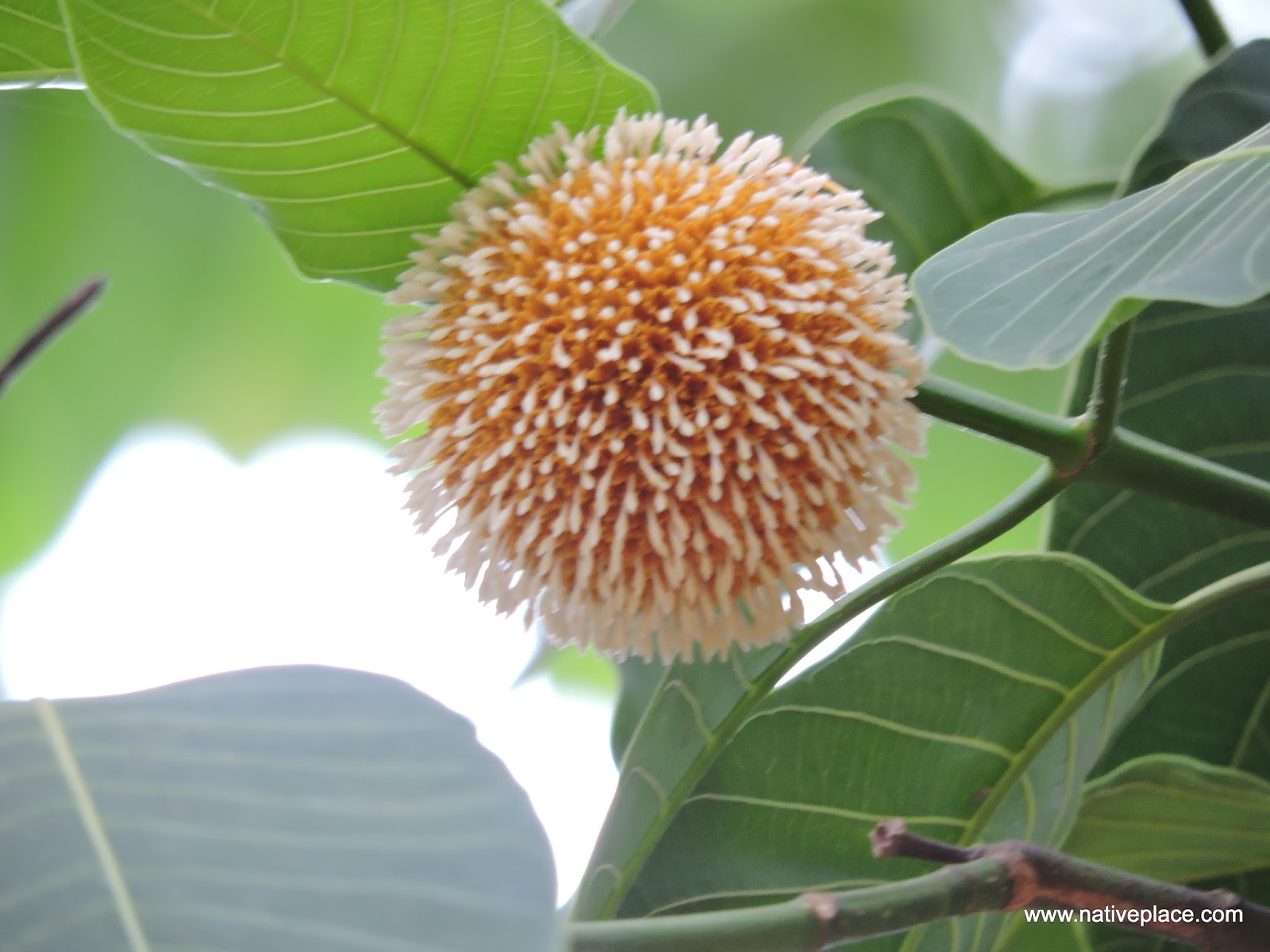
Kadamb (Anthocephalus Cadamba/कदंब) or The Common Bur Flower is a large, handsome, umbrella shaped tree with branches arranged in whorls around the central trunk. It is evergreen, fast growing and has a graceful appearance.  It produces unique globular shaped flowers coloured a striking yellow to orange.  
 In India the tree is mainly associated with Lord Krishna and stories about him and his gopis prancing about in the forests of Brindavan among the Kadamba groves abound.  This tree is also closely associated with the Mother Goddess (often referred as Kadambavana vasini) "She Who Resides in the Forest of Kadamba Trees."

We have a lovely specimen of this legendary tree in the Native Place Garden that we planted about 7 or 8 years ago having been intrigued by the lore of its beauty as well as its mythological and ecological associations.  You can enjoy its beauty and shade throughout the year but in the month of May the tree offers a special sensory experience when it flowers in profusion, showing off its quaint yet beautiful flowers that attract a host of bees and exude a heady perfume. And as the flowers drop one finds the curious golden globes scattered all around the tree waiting to dry off and release thousands of little seeds.

We have built a low wall all around our Kadamba tree. A silent invitation to you to come sit under this tree and enjoy the ambience it conjures.

The Kadamba Anthocephalus Cadamba  is often mixed up with the Kaim – Mitragaayne parviflora  a tree that is dominant in the forests of Brindavan. Both spcies produce globular blossoms but the Kaim’s flowers are not as striking  to look at. They also differ greatly in canopy and leaf shape. Where the Kadamba has a straight bole and branches arranged in upward reaching whorls the Kaim has a fairly meandering trunk.

i came across the Kaim in the “Trees of Delhi” by Pradeep Kishen. Pradeep  sheds light on this confusion/ puzzle on page 149 –  where he informs us that the REAL Krishna Kadamb  of Brindavan is Neelamarcia  cadamba ‘Kaim’ not Anthocephalus Cadamba ‘Kadamba’  which  is unique to moist  forests in the NE of  India and would not survive unaided in the hot dry  Brindavan area.  Kaim on the other hand is not only native to the remnant Brindavan forests but is their dominant tree. But in the Brindavan region the Kaim is called kadamb  J  no wonder the confusion !

Oh well !!! Our Kadamba may not bring to mind the visual of Krishna playing his flute any more but it remains the tree closely associated with the Mother Goddess  - Kadambavana vasini "She Who Resides in the grove of Kadamba Trees."
The tree is said to be vanishing from Indian forests and needs to be planted and celebrated once more for it its beauty, functionality and usefulness.
Some Uses
This beautiful tree is also known for its medicinal virtues. The tree has astringent & antipyretic properties. It is believed to have cure for ulcers, digestive ailments, diarrhoea, expectorant, fever, vomiting etc.

A yellow dye is obtained from the root bark. Kadamb flowers are an important raw material in the production of attar, Indian perfume with Sandalwood (Santalum Album). The tree is grown along avenues, roadsides and villages for shade. The fresh leaves are sometimes used as plates.


In Permaculture
The Kadamba is suitable for reforestation programs. It sheds large amounts of leaf and non-leaf litter which on decomposition improves  the  physical and chemical properties of soil.

Cultural aspects
It is common belief among the natives of many villages in the state Chhattisgarh that plantation of Kadamb tree near to lakes and ponds, brings happiness and prosperity in their life.


Friday, June 5, 2015

The Firefly Phenomena in the Native Place Garden

It happens in the transition of seasons, when summer is on its last legs and the SW monsoon winds begin to penetrate inland signaling the beginning of the monsoons season.  Every night starting at the end of May the Native place garden comes alive, lit up by magical fairy lights. It begins with a single spotting, a few days later a few more and soon the numbers increase until they reach an amazing intensity by the time the monsoon arrives.

Even in the light of the waxing moon these fairy like creatures are mesmerizing to look at.  Fireflies can be seen all over the garden lighting up shrubs, hedges and tree canopies but they do seem to have preferences for certain flora.

Look out from the Native Place  terrace into the canopy of the little Ain tree to see smatterings of ephemeral lights gliding about, floating up and sinking down like graceful glowing embers from a bonfire.  The whole tree seems alive with the many random, slow, fluid movements and lighting rhythms. Watching these guys for a while brings on a sense of awe and quiets the mind. 

Another Ain tree a little further away has another vibe going on altogether. Here we see lots more fireflies going off in a pulsating synchronized  fashion  sweeping up from the bottom or the top or even initiating spontaneously from the middle of the tree canopy. Sitting on the steps looking up at this insignificant by day tree one can’t help but feel lucky to be here right now witnessing the energy that dwells in it.


 My fancies are fireflies, specks of living light twinkling in the dark.

Tagore

When was the last time you saw fireflies?

For many of us who have been born and raised in the city, fireflies may have well been the subject of fairytales and myths. But you too can have this special experience by simply booking a night’s stay at the Native Place guesthouse at Kamshet (3 hours from Mumbai and one hour from Pune

Come experience the magic of the fireflies in the Native Place garden. These seemingly magical insects will be on show in full intensity for the next couple of weeks. 

This phenomena begins at the end of May and continues to increase in intensity until the monsoon begins in full swing – a short period of a few illuminating, magical weeks . Come make the most of this opportunity.

Mail us at info@nativeplace.com

Visit our website www.nativeplace.com

Follow us on facebook https://www.facebook.com/pages/Native-Place/147992775230428


Astrid Rao 


Tuesday, July 29, 2014

Pink & Purple


It is the monsoon season and the predominant color is green but pink purple and silver seemed to be the theme of the weekend – there were Michelle’s purple boots that were driving me insane – all I could think of was I want I want I want

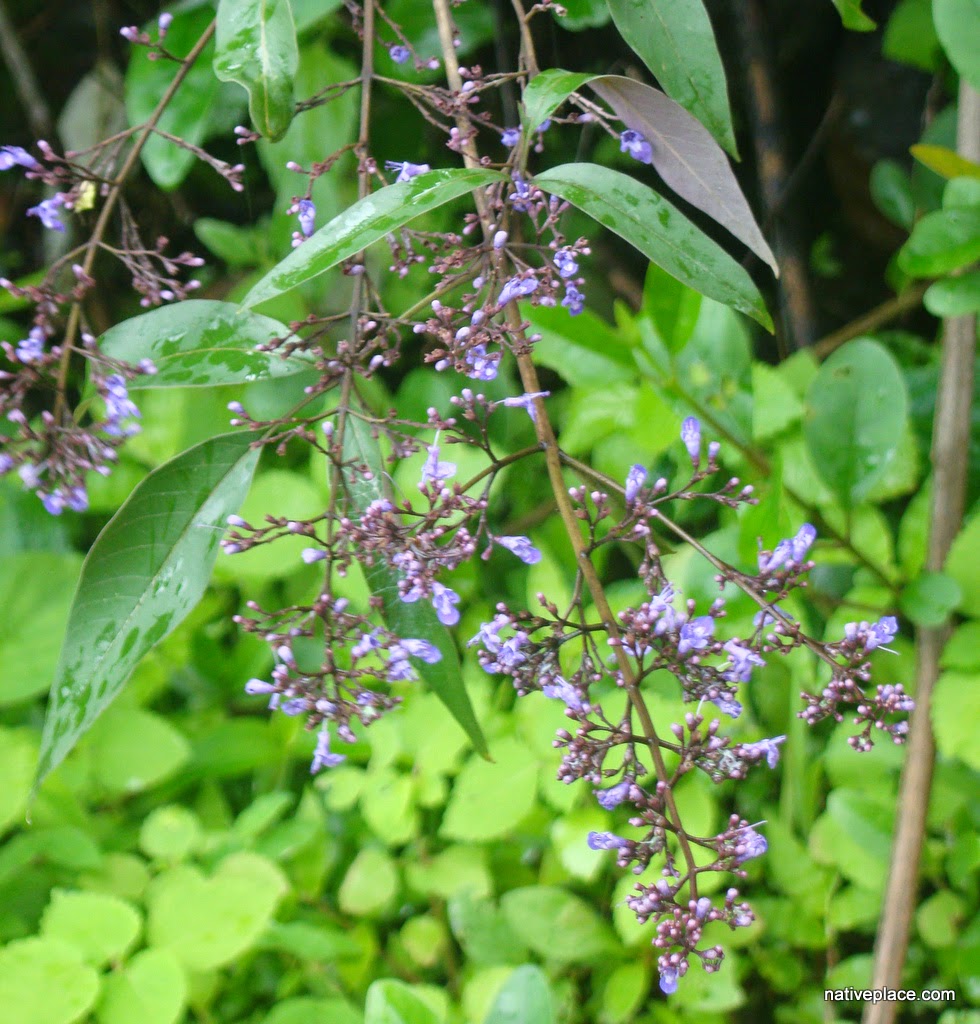
Then we noticed 2 varieties of Vitex Negudo in flower

and the pink frangipani that we had planted 2 years ago

The check dams we had built them in summer seem to be working like magic – tiny little silvery water falls

We came across a tree fall – check Dwane drinking this moss charged water

A medicinal plant in flower – one of the Dashamularisht that is supposed to be in short supply and may be endangered also pink (sorry I don’t know the name)


Green – the color of the paddy we have planted – next weekend is transplanting time so guys if you want to get your feet squishy in muck and plant the rice that we will serve you soon … come on over 


Come on over :)

Peace Bliss & Happy Landings 

Astrid & Sanjay Rao 

Saturday, April 5, 2014

Back Home at Native Place


Dwane sends me proof that the Palash is in flower :) 
Last week I visited Native Place for the weekend after a very long time.  In fact I had last been there during the Diwali holidays in November. My son’s exams had kept me busy in city and now finally I was able to get to Native Place. 4 long months of being away and yet once I was there it was like I had never left. Of course I had missed out on the flowering of the Palash and the Red Silk Cotton tree. I had missed many a harvest of vegetables from the garden and the birds too seemed to have gone away for the summer.

On Saturday morning I woke up and went into the balcony to see and hear a bunch of about 40 Bulbuls fooling about in the trees – there was a constant movement within the canopy of the Umbar, Jamun  and the Mahua trees as pairs chasing each other from one tree or branch to another – what a glorious site it was to see these birds at play.
Blue Flycatcher in the Naive Place Garden
It struck me then that Bulbuls was all I had seen – where had the ioras gone to I wondered – not many sunbirds to be seen either and as I thought these thoughts I spotted a flycatcher yes a Blue Flycatcher right there on the Umbar tree – a beautiful sight it was and made me very happy.

Then later Eknath the gardener showed me a Bulbul sitting in its nest – wonder if there will be chicks in the nest when I go up next. I showed it to Saumya – Vrinda and Chetan’s little girl and she was thrilled. Oh! The simple pleasures that fill the heart.

T
Another treat in the garden was the Petrea Volubilis in flower. -  such a graceful climber - here is a picture taken from my balcony

And now to look forward to a glorious summer with lots of paragliding, bird watching,  gardening and perfecting the art of sitting in a hammock and doing nothing 

 Peace Bliss and Happy Landings 

Astrid Rao   

Sunday, February 5, 2012

One day Hornbills will visit my garden


Years ago I used to watch an animated tv series called the Wild Thornberries with my son Sunith.   A show about a little girl called Eliza Thornberry who travels the world with her famous nature show host parents and falls into exciting wildlife adventures.

On one such show the Thornberries were on an expedition somewhere in India hoping to film a species of a rare Hornbill. In the episode they were camped out in the forest clearing near some huge trees laden with wild fruit that the Hornbill loves to eat.

This episode stayed with me and when I first started planting trees at Native Place I looked for species that attracted birds. I had imagined the whole thing unfolding in front of my eyes. Planting the trees…watching them grow and bear fruit… the birds arriving to nest and feast on the fruit

Much later I got to know that the Hornbill’s loved to eat wild figs. This was amazing to me -  they loved the fruit of the one lone large specimen i.e. the Umbar tree that existed in Native Place garden. I quickly jumped to the happy conclusion that since we have an Umbar (wild fig) in the garden that fruits copiously we should be graced with Hornbills.  Rather simplistic thinking considering that these noisy, social, omnivorous birds need large tropical forest areas with many fruiting trees throughout the year to survive. But there were forests in the hills around and so I continued to have hope. A couple of years ago we spotted our first pair of Hornbills in the garden and soon they became a regular sighting in the Native Place garden.

I put a picture up a few weeks ago on facebook and Anand Pendharkar congratulated us as the Indian Grey Hornbill (Ocyceros birostris) is an indicator of intact forests and deserves conservation attention.

We are so grateful for our beautiful Umbar tree  and all the denizens in the garden that it supports and nurtures.

Shine on Umbar tree!

Peace Bliss & Happy Landings

Astrid Rao
www.nativeplace.com
www.flynirvana.com

Wednesday, March 18, 2009

Better late than never


I have a Palash tree in the garden that has not flowered at least not in the past 5 years that i have been watching and waiting. It was on the plot before we built the house and i was very excited to have it but it dissapointement every March by staying green rather than shedding its leaves and developing a profusely flaming crown.

But this season it surprised me - no profusion of orange but a few reluctant blooms as you can see above - enough to bring joy to my heart though. Here below you see pictures of another Palash that i came across on a walk in the hills blooming in all its glory.


Palash: is an indigenous species found in open country. Scientific name Butea monosperma, it is also known as the flame of the forest,Dhak,Tesu, kesu, chhichra, Bengal Kino and bastard teak. Floweres contain nectar and attract many birds. Leaves are used to make plates and the flowers yeild a orange dye used at Holi.

Astrid Rao

Tuesday, April 22, 2008

The Tree of Life


The Mahua trees in the garden are clothed in vibrant new coppery red young leaves again and their graceful oval crowns are delightful to look at especially in the sunlight.

There were two young saplings growing wild on our plot when we first started gardening here. Insignificant looking but on identifying them I decided to give them room to grow.

They are known in Central India as the tree of life to the tribes of the region and considered to be sacred. It is said that the Mahua tree is a sentinel that guards the Adivasis (forest dwelling tribals) from cradle to the grave and true-blue Adivasi will ever cut down a Mahua tree, which is revered and worshipped.

No Adivasi ritual is complete without the ubiquitous mahua - much like plantain ( Banana) trees elsewhere. They keep a nightly vigil to save the fruit from the animals and collect them at dawn. They eat the dried flowers, make sweets out of it and make potent liquor called Sidhu from it too. My dad who used to go hunting and knew a lot about the ways of the jungle and its people had told me about this when I was a child.

Their scented sweetish fleshy flowers are an irresistible attraction to nectar and fruit eating birds that are reported to get drunk when they peck fermented flowers. Bears and deer also eat the flowers that fall at night and get intoxicated. This tree reminds me of its counterpart the Amrula tree that I came across in the movie Beautiful People where the animals got drunk after eating its flowers.

I love their graceful oval shape and find it looking its cheerful best at this time of the year.

Astrid Rao

Saturday, March 15, 2008

The Ides of March


It is not yet the middle of March and the area around Native Place wears a dry, stark, look. The grass has all been foraged and all that is left is bleached out white stubs. The crafty goats seem to prefer the thorny scrub bushes to the unpalatable dry grass. Can’t imagine how much more scorched the land will get over the next two summer months of April and May.

The trees as I mentioned earlier are stoutly holding the fort. Around us the Red Silk Cotton tree and the Indian Coral tree are gloriously in bloom adding bright colors to the stark contrasts in the area as are the Palash (flame of the forest) and the Sterculia (Bonfire tree) that came into their own last month. It’s amazing to see all these fiery brightly colored trees which have common names associated with fire doing their bit for nature’s palette.

Soon we will have the festival of Holi upon us. In earlier times flowers of the Red Silk Cotton and Palash were used to make organic color that was used in the festival. But today ready-made chemical substitutes are widely used instead of organic ones and as the trees loose their uses they loose their place in man’s world.

Thursday, March 6, 2008

In the shade of the old Umbar tree


When we acquired the plot of land on which Native Place now sits, my only regret was that there were no trees growing on it. I later came to know that according to a custom when land is sold the seller could cut off the trees and take away the wood.

Once we began to build native place this stunted low canopy that had missed detection as tree even though it had a huge trunk began to grow – and how it grew. During the first year it grew to the height of the first level and by the next year it was at the height of the 2nd level of the house.

Today it is a large dense canopied tree under whose shade tents and hammocks are strung and whose branches are inviting to visitors young and old. Spend an afternoon in the hammock under this tree and depending on the season you will glimpse tailor birds, sun birds, bulbuls, ioras, leaf birds, orioles, leaf warblers, and many more birds

Over the years we got more and more familiar with this wonderful tree. It is known by different names such as 'Gular', 'Udumbar', or ‘Umbar’. Its Latin name is Ficus Glomerata Roxb. It is also known as Cluster fig. It is found all over India and grows wild in the forests and hills. It has many religious associations, a host of medicinal uses and many myths are also associated with this tree.

According to Buddhist scriptures, the Udumbara blossoms every three thousand years and is believed by Buddhists to be a sign of an overwhelming blessing and good fortune. Udumbara is an imaginary flower that only blossoms every 3000 years when the King of Falun comes to the human world. A collection of Buddhist sutras, claim this heavenly flower is a sign of rare preciousness and a miracle.

In Maharashtra it is venerated as the abode of Lord Dattatreya and therefore not cut. I learnt this from the old caretaker of the plot who told me that is the reason why the tree was saved. So it was by the intervention of the gods after all that we were given this mother of a tree that sustains and nourishes a variety of creatures, us included.

You will be hearing more about this special tree in the future

Astrid Rao