Pages

Showing posts with label Native Place Guesthouse. Show all posts

Wednesday, March 13, 2019

Valentine's Weekend at Native Place, Kamshet


This Valentine’s day weekend Native Place hosted “Color’s of Love” an event where people came together to celebrate Love of nature.  The event attracted a beautiful set of people looking to escape the city, immerse in  nature and have a change of scene. The highlight of the weekend was the Natural Dyeing workshop conducted by Anushree Chitnis.

Besides, there was rooftop music performance, a bonfire, nature walks and simply chilling out in the flower filled Native Place garden, harvesting veggies and making flower mandalas. People were blown away by the beautiful Jade vine, a gorgeous sunset and then there was a music performance on the roof where B Mohanty charmed us with her beautiful voice. 
Anushree Chitnis a Landscape Architect and Permaculture Designer with a penchant for plants and all things natural took the eager participants through the history of plant-based dye making transporting them to the times when colors were all natural made of ingredients from one’s kitchen or garden.
Participants collected palash flowers, sorted onion peels, tore up purple cabbage and pounded turmeric. The ingredients were brewed in the outdoors on a wood fired stove that added to the feeling of stepping back in time. 

“Another great weekend  at Native Place - learning new things, making new friends, rooftop party, bonfire, nature walks and great food.  From insane blue/green Jade Vine flowers, to the beautiful indigo and ochre shades we made, from the beautiful sunset to the vivid greens - this weekend was truly colourful :)” Roly Saraswat,  participant

About Anushree Chitnis
A landscape architect by profession, Anushree is a gardener at heart. Her observations and experiments have led her to design spaces that encourage not just people but also, birds, bees and insects to spend time in these eco-niches!
Her love for nature also extends itself towards her art work including murals, sketches, up-cycled objects and recently, paintings with natural dyes and inks. She believes the world of natural dyes is a complete sensory and unwinding experience, always full of surprises when embraced with an open mind.
Anushree currently runs an independent design practice, Studio Folium, offering landscape and permaculture design, interior design and art commissions representing bio-diversity. 
Follow her Instagram Page: @anushree_la 
Facebook:https://www.facebook.com/anushree.chitnis 
Linked In : https://in.linkedin.com/in/anushree-chitnis-b2212234


Monday, April 24, 2017

Native Place Easter Special


This Easter weekend we had a fun Easter Egg Huntat the Native Place Guesthouse followed by a special ‘East Indian’ Easter lunch. We had invited children from Palegaon ( the nearest village) to take part in the hunt. 


The children arrived at 10.30 and sat shyly in a group. We invited them to join us blowing up balloons. This worked as an icebreaker and soon they were all running around helping with the decorations.


To continue the mood of excitement we played a game - anyone heard of ‘Mamachya patra haravla’ ? It’s the local version of ‘a tisket a tasket’ a kindergarten game I’ve played myself as a child. Such a simple delightful game – one could feel the nostalgia as our garden crew and the paragliding crew spontaneously joined in the fun.

Before we knew it chairs were being called for and musical chairs was next on the plan – have to say it was so much fun that the Nirvana Adventures paragliding students and guests also wanted to play
Next came the Spoon and Lime race – Vinod won hands down – he seemed to have a cheat code of some sort but we never figured it out J .  

 Finally it was time for the Easter egg hunt but i have to say that it did not last too long – the kids were so sharp eyed that within 10 minutes all the goodies were in the bag or should i say basket.


It was a fun morning and everyone had a great time – we are inspired to do it again next year
Mark the dates and see that you show up.  


Astrid Rao
info@nativeplace.com


Thursday, December 8, 2016

The Permaculture Patshala comes to Native Place, Kamshet


December 2nd 2016, a varied group of 28 eager participants converged at Native Place for a 3 day Introduction to Permaculture Course. Attracted by the opportunity to learn the basics of growing their own food , mangling soil fertility, setting up regenerative systems,  water harvesting,  biodiversity regeneration etc  and to understand the inter-relationships among all of these.

Under the guidance of Narsanna Koppula, India’s pioneering permaculture practitioner, with his decades of experience in this field, this 3 day course turned out to be a power packed learning experience fulfilling the needs of the various participants - some were working on their land, some had plans to buy land, some were involved in urban terrace farms and some were simply curious.

Narsanna skilfully guided the participants though the fundamentals , the basics of permaculture practices and principles.  Lectures & Interactive discussions, plenty of hands-on practicals, Palikade Farm site visit and tree identification walks.

The Native Place garden, a permaculture project in progress, spread over many levels, packed with bio diverse plantings and an impressive list of native trees - provided the perfect setting. After the initial talk in the yoga room a semi open meeting space at the bottom of the garden, Narsanna led them out into the garden where he preferred the many shady seating areas in the garden  much to the delight of the participants.

Each day the program went on till late in the evening followed by dinner,  a short film on permaculture,   singing and bonding.

They were a lovely bunch of people from Mumbai,  Pune, Nasik, Bangalore, Germany and Canada.  They came together as individual participants but emerged into a cohesive group bound by common interests and the promise of growing sharing and supporting each other in the journey to apply permaculture in their lives. 

Cheers to the Permaculture Patshala and all who energize it

 Astrid Rao & Sneha Shetty 

Narsanna Koppula is a permaculture pioneer in India. Along with his wife Padma Koppula, he founded the organisation AranyaAgricultural Alternatives that works with rural farming communities in Andhra Pradesh and Telangana in applications of permaculture and natural resource management. In recent years, through his Permaculture Patshala, Narsanna has also been sharing the wealth of his 30 years of experience with urban folks from across India and the world, who are attempting to return to land and live in harmony with nature. His organisation is also hosting the 13th InternationalPermaculture Convergence in India in November 2017. 

Saturday, July 2, 2016

Palikade Permaculture Project – Water Harvesting & Soil Conservation (WH & SC)


 The Native Place guesthouse and garden is a labor of love that we have tended to since early 2000.  Today the garden comprises a delightfully diverse group of flora and fauna. a paradise for tree lovers and birders and everyone who loves  nature and gardening. It is exactly what we had envisioned it to be and more but being just an acre and a half in area we soon ran out of place to accommodate the plant palette (our wish list of trees).  Palikade, (an 18-acre plot of land in Thoran Village) that we acquired for this express purpose, is where we intend to manifest this dream. The vision is to develop Palikade as a self-sustaining farm & tropical food forest aimed at facilitating harmony amongst all stakeholders in the habitat (the birds, insects, microorganisms and other animals as well as us humans).

We were aware that it was very important to work on Water Harvesting & Soil Conservation (WH & SC) structures as a priority before planting trees on a large scale. These are also called ‘landforms’.  The land at ‘Palikade’ comprises two fairly flat areas of land divided by a huge gully running in between. The slopes and high rainfall combination in this region meant that significant soil and water was running off the land every monsoon. Also, rain is the only source of water on this land, so, the sooner we undertook the work on landforms, the lesser would be the loss of precious soil and greater the gains of water retention.

The Permaculture Design Course (PDC) that we attended in March 2016 gave us significant confidence with respect to the understanding of WH & SC. We undertook practical work at the PDC, designing and creating WH & SC structures like contour trenches, percolation tank, gully plugs and brushwood. Our two gardeners at Native Place, Anil & Eknath, attended two days of Water Harvesting sessions at the PDC and  thankfully they too learnt the basics and were able to support us in this effort.

Our journey of implementation started with inviting Narsanna to Palikade when he gave us some crucial inputs regarding WH & SC work. Thereafter, we invited Osman Baig, a watershed expert who we met during the PDC, to guide us with the location for different WH & SC structures. Osmanji, came in April for two days and helped us mark the area for a percolation tank, a pond, trenches & bunds and some gully plugs. We asked him plenty of questions so that we understood the logic of all his inputs.

Thereafter, we got down to detailed marking of all the structures on the land. We then did rough measurements around the entire land & drew out the plan and designs on paper. This helped us get greater clarity of the overall picture. The next step was actually making these structures with the help of a JCB and manual labor.

We also figured the details from local sources that annual rainfall in this area was about 2,500mm, number of rainy days was 82 and the highest rainfall in 24 hours was 176 mm. This helped us decide factors like the depth of the trenches to be dug and the distance at which contour trenches needed to be dug.

Some details about the structures are provided along with the individual pictures in this album. Need to specially mention here about the Percolation tank (PT) and pond. Part of this property (about 1 acre) is on the other side of a road, towards the South. It has high slope. At the bottom of this sub-plot, there is the possibility of accumulating water from a catchment of about 7 hectares. Hence a PT was created right there. The water that is likely to accumulate there is being routed to another pond on the farm, through a pipe running across & under the road. 

On his subsequent visit, Osmanji also identified the scope to route more water to the pond by creating a rainwater diversion trench. He also suggested developing a micro-pond in the Western side of the plot – this area was quite rocky and was sloping towards a small gully, which further met the main gully.

By end of May, we had completed all the landforms work. The structures we created have the capacity of holding about 34 lac liters of water at one time.

Structures
Capacity - Volume
About 1,200 running metres of deep trenches and bunds
1200 m3
12 lac litres
Percolation tank
350 m3
  3.5 lac litres
Pond
1700 m3
17 lac litres
Micro pond
100 m3
  1 lac litres
Staggered trench
14 m3
14,000 litres
Capacity / Volume(approx.)
3,407m3
33.64 lac litres

Simultaneously, in April & May, we were working on designing the plantation on these WH & SC structures, collecting seeds directly from trees & from friends & networks, growing saplings in our own nursery at the Native Place guesthouse & also scouting nurseries for plants that we were not growing ourselves. By second week of June, we were all equipped to start planting - the story of which you may have read in our previous post regarding the plantation J


This has been the first phase of WH & SC and plantation. We intend to take this forward step by step and attempt more intricate permaculture applications. The aim is to conserve & impound rainwater, raise aquifer levels, enhance soil health, create micro climates and an abundant habitat!

We’ve never felt we had completed anything very significant until now. But the amount of inquiries we received from our farmer friends for a detailed account of the work pushed us to do this write up. Feeling humbled & grateful.

In Solidarity,


Wednesday, June 15, 2016

Cormorants Galore!

Last week at Native Place i happened to go up to the terrace after breakfast and was rewarded by the sighting of a huge flock of cormorants hunting for fish. A whole swarm of them were encircling an area presumably there were lots of fish there. From the distance they made a magnificent sight – the surface of the water was disturbed with their flapping wings as they swirled around creating a huge circular cauldron, diving in, running on water and flapping about. A few straggler egrets added to the drama creating a black and white canvas against the blue waters.  


I checked out this new phenomenon that seemed to be unfolding right in front of us for the next few days just to be sure and yes – it was happening every day. Wow!!!  Such a wondrous sight!

For the first time one can see what seems to be the entire colony fishing together and it makes quite an impact on the senses.

Cormorants have been a common sight by the lake shore at Native Place. Through the year one could spot the odd group in the mornings by the lake shore, diving for fish and perching on tree tops and bushes by the shores wings spread out to dry in the sun.  During summer evenings one had these exhilarating sightings where one looked up by chance to suddenly spot wave upon wave of V shaped flocks akin to migrating geese as they flew back to their roosting spots for the night (or so i believed)
In the recent years an entire colony has  taken to roost in a grove of acacia trees on a narrow spit of land that juts out into the lake  just a few years ago becoming our neighbors. J

Since then we have had the pleasure of watching them at sunset time as they circle around the area and then head for a tree. Lots of squawking and shoving goes on at sunset until they go quiet for the night.

It’s lovely to have a pristine water body before you and spot lake shore birds but to see an entire colony intently at work circling low over the lake is surely special!

The pictures above simply don't convey the largeness of the phenomenon - you have to see it to feel it ! Come connect with nature at Native Place.

More about Cormorants: - Cormorants are large black, fish eating birds with a long,  hook tipped bill.They  are daytime feeders that hunt alone or in flocks.  Cormorants feed by diving and swimming underwater. They can dive to depths of 5 to 60 feet below the surface and stay under water up to 70 seconds. They eat mostly fish and sometimes small invertebrates. Cormorants use their webbed feet to propel them underwater. Cormorants run along the surface of the water to gain enough speed for flight.  Watching these diving birds by the lakeside is a wonderful way to spend time.

Connections: - Recently i came across an interesting piece of info relating the presence of cormorants to tarpon fishing -
When you eat like a cormorant — which is a lot — you poop like a cormorant — which, again, is a lot. This potent concoction falls from the cormorant's precarious perch, entering the food chain only a few feet below. Bacteria then grow in this enriched, (let's call it fertilized) water. Soon the plankton count their lucky stars while feeding on this heaven-sent bounty. Small invertebrates and protozoa’s gorge on the plankton, and on and on it goes up the line. Shrimp, crabs and sardines bless father cormorant before gorging on the millions of minute krill or the collected organic detritus they leave behind.

At the top of this food chain are the tarpon. They come for the bounty the cormorant droppings provide and, with the tarpon, come the anglers. It is simple math: more cormorants mean more food for the tarpon's prey. More guano creates more food and more food means more tarpon.  
Perhaps we shouldn't be so judgmental about cormorants and their greedy eating and pooping habits. Perhaps we should be glad these ancient avians do their digesting where they do. Perhaps we should be glad they haven't better mastered the air. Perhaps we should be pleased they only use flight to get to the fishing grounds and then trundle home again, straight for the mangroves.
Some guides in Mexico say that they kill cormorants because they eat baby tarpon. Gentlemen … haven't you learned by now that it is best not to mess with Mother Nature? Let her be. She has things pretty well worked out, and her devices usually work to the benefit of the angler. Mess with her, and you just may be killing the goose that laid the golden egg. Although in this case it may not be a goose, but a cormorant, and it may not be an egg, but a pile of … OK, OK.  You get the picture. So let's all bless the cormorants.
 Astrid Rao 

Monday, June 13, 2016

Announcing the arrival of the Malabar whistling Thrush in the Native Place Garden


Folks – they have arrived!  We spotted a pair last week scouting around the Nirvana Cottage Wing for a nesting space. Heard the predawn song a few days ago a sweet whistling and had an easy spotting soon after. Watched the pair happily at work – seems like they too are happy to be back (they have been nesting here for a few years now) We will now have the pleasure of watching them as they select a nesting spot and build their nest, bring new chicks into he world and then work hard together to feed the young chicks who have voracious appetites.
Ah – so looking forward to this ! J
Also known as the ‘Whistling Schoolboy’ for the whistling calls that they make at dawn  - a slow soft mellifluous call with a sense of aimlessness about it.  Sounds like a carefree schoolboy whistling to himself as he strolls along.
The species is said to be resident in the Western Ghats although it visits the Native Place Garden to breed and raise its young.  I have read that they can be spotted near rocky streams and in riverine habitats either in the shady undergrowth or in a really difficult to spot location and are usually most active at early dawn or dusk making them difficult to photograph

This large thrush appears blackish with shiny patches of blue on the forehead and shoulders. It is omnivorous, eating a wide range of insects. crabs, frogs, earthworms and berries.


Which Kadamba Tree ?

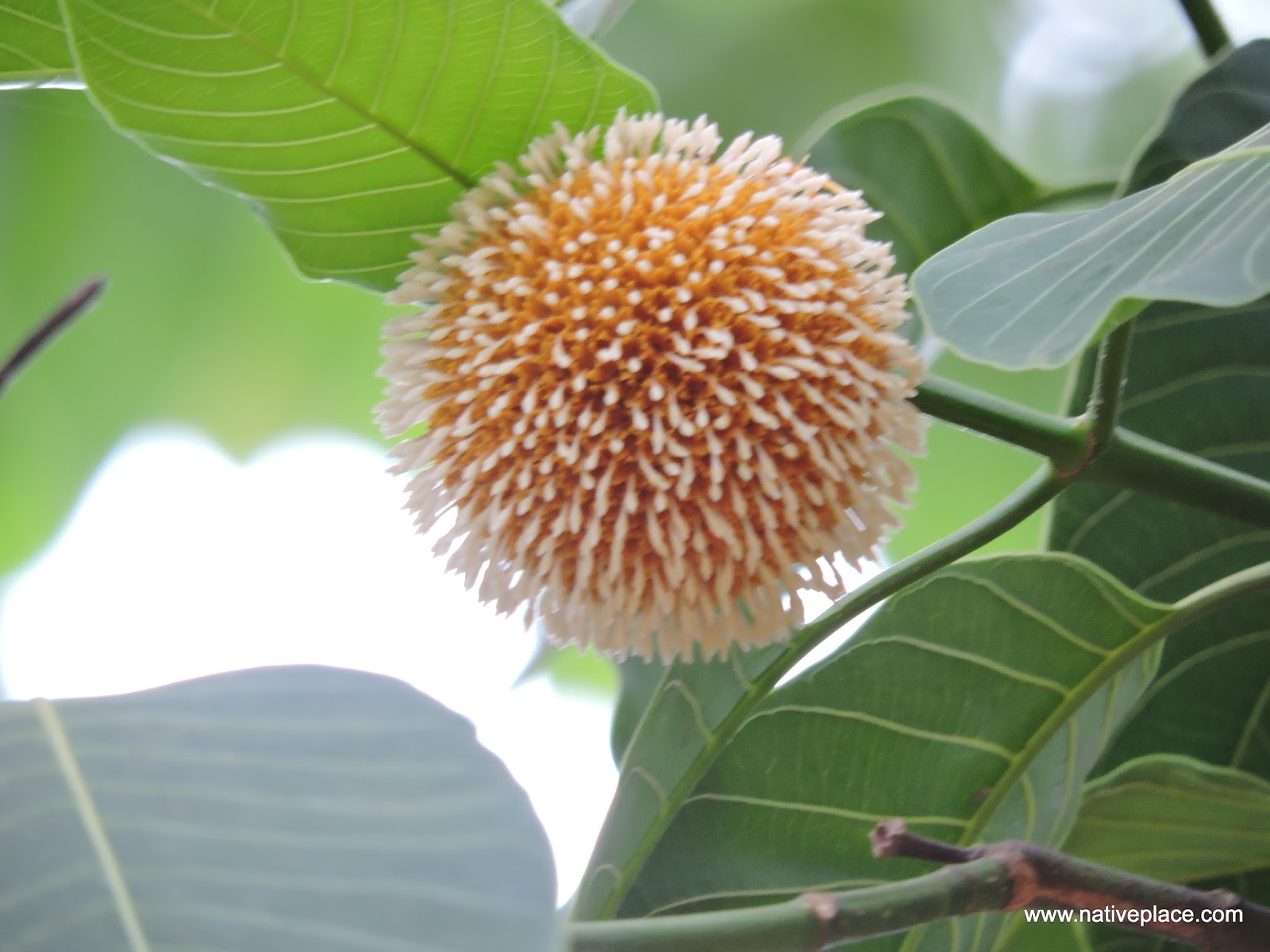
Kadamb (Anthocephalus Cadamba/कदंब) or The Common Bur Flower is a large, handsome, umbrella shaped tree with branches arranged in whorls around the central trunk. It is evergreen, fast growing and has a graceful appearance.  It produces unique globular shaped flowers coloured a striking yellow to orange.  
 In India the tree is mainly associated with Lord Krishna and stories about him and his gopis prancing about in the forests of Brindavan among the Kadamba groves abound.  This tree is also closely associated with the Mother Goddess (often referred as Kadambavana vasini) "She Who Resides in the Forest of Kadamba Trees."

We have a lovely specimen of this legendary tree in the Native Place Garden that we planted about 7 or 8 years ago having been intrigued by the lore of its beauty as well as its mythological and ecological associations.  You can enjoy its beauty and shade throughout the year but in the month of May the tree offers a special sensory experience when it flowers in profusion, showing off its quaint yet beautiful flowers that attract a host of bees and exude a heady perfume. And as the flowers drop one finds the curious golden globes scattered all around the tree waiting to dry off and release thousands of little seeds.

We have built a low wall all around our Kadamba tree. A silent invitation to you to come sit under this tree and enjoy the ambience it conjures.

The Kadamba Anthocephalus Cadamba  is often mixed up with the Kaim – Mitragaayne parviflora  a tree that is dominant in the forests of Brindavan. Both spcies produce globular blossoms but the Kaim’s flowers are not as striking  to look at. They also differ greatly in canopy and leaf shape. Where the Kadamba has a straight bole and branches arranged in upward reaching whorls the Kaim has a fairly meandering trunk.

i came across the Kaim in the “Trees of Delhi” by Pradeep Kishen. Pradeep  sheds light on this confusion/ puzzle on page 149 –  where he informs us that the REAL Krishna Kadamb  of Brindavan is Neelamarcia  cadamba ‘Kaim’ not Anthocephalus Cadamba ‘Kadamba’  which  is unique to moist  forests in the NE of  India and would not survive unaided in the hot dry  Brindavan area.  Kaim on the other hand is not only native to the remnant Brindavan forests but is their dominant tree. But in the Brindavan region the Kaim is called kadamb  J  no wonder the confusion !

Oh well !!! Our Kadamba may not bring to mind the visual of Krishna playing his flute any more but it remains the tree closely associated with the Mother Goddess  - Kadambavana vasini "She Who Resides in the grove of Kadamba Trees."
The tree is said to be vanishing from Indian forests and needs to be planted and celebrated once more for it its beauty, functionality and usefulness.
Some Uses
This beautiful tree is also known for its medicinal virtues. The tree has astringent & antipyretic properties. It is believed to have cure for ulcers, digestive ailments, diarrhoea, expectorant, fever, vomiting etc.

A yellow dye is obtained from the root bark. Kadamb flowers are an important raw material in the production of attar, Indian perfume with Sandalwood (Santalum Album). The tree is grown along avenues, roadsides and villages for shade. The fresh leaves are sometimes used as plates.


In Permaculture
The Kadamba is suitable for reforestation programs. It sheds large amounts of leaf and non-leaf litter which on decomposition improves  the  physical and chemical properties of soil.

Cultural aspects
It is common belief among the natives of many villages in the state Chhattisgarh that plantation of Kadamb tree near to lakes and ponds, brings happiness and prosperity in their life.


Friday, June 5, 2015

The Firefly Phenomena in the Native Place Garden

It happens in the transition of seasons, when summer is on its last legs and the SW monsoon winds begin to penetrate inland signaling the beginning of the monsoons season.  Every night starting at the end of May the Native place garden comes alive, lit up by magical fairy lights. It begins with a single spotting, a few days later a few more and soon the numbers increase until they reach an amazing intensity by the time the monsoon arrives.

Even in the light of the waxing moon these fairy like creatures are mesmerizing to look at.  Fireflies can be seen all over the garden lighting up shrubs, hedges and tree canopies but they do seem to have preferences for certain flora.

Look out from the Native Place  terrace into the canopy of the little Ain tree to see smatterings of ephemeral lights gliding about, floating up and sinking down like graceful glowing embers from a bonfire.  The whole tree seems alive with the many random, slow, fluid movements and lighting rhythms. Watching these guys for a while brings on a sense of awe and quiets the mind. 

Another Ain tree a little further away has another vibe going on altogether. Here we see lots more fireflies going off in a pulsating synchronized  fashion  sweeping up from the bottom or the top or even initiating spontaneously from the middle of the tree canopy. Sitting on the steps looking up at this insignificant by day tree one can’t help but feel lucky to be here right now witnessing the energy that dwells in it.


 My fancies are fireflies, specks of living light twinkling in the dark.

Tagore

When was the last time you saw fireflies?

For many of us who have been born and raised in the city, fireflies may have well been the subject of fairytales and myths. But you too can have this special experience by simply booking a night’s stay at the Native Place guesthouse at Kamshet (3 hours from Mumbai and one hour from Pune

Come experience the magic of the fireflies in the Native Place garden. These seemingly magical insects will be on show in full intensity for the next couple of weeks. 

This phenomena begins at the end of May and continues to increase in intensity until the monsoon begins in full swing – a short period of a few illuminating, magical weeks . Come make the most of this opportunity.

Mail us at info@nativeplace.com

Visit our website www.nativeplace.com

Follow us on facebook https://www.facebook.com/pages/Native-Place/147992775230428


Astrid Rao 


Monday, December 8, 2014

Scaly Breasted Munia at Native Place, Kamshet


Winter approaches and at Kamshet the paddy in the fields is ready for harvest. Driving through one can see people hard at work harvesting the grain. 

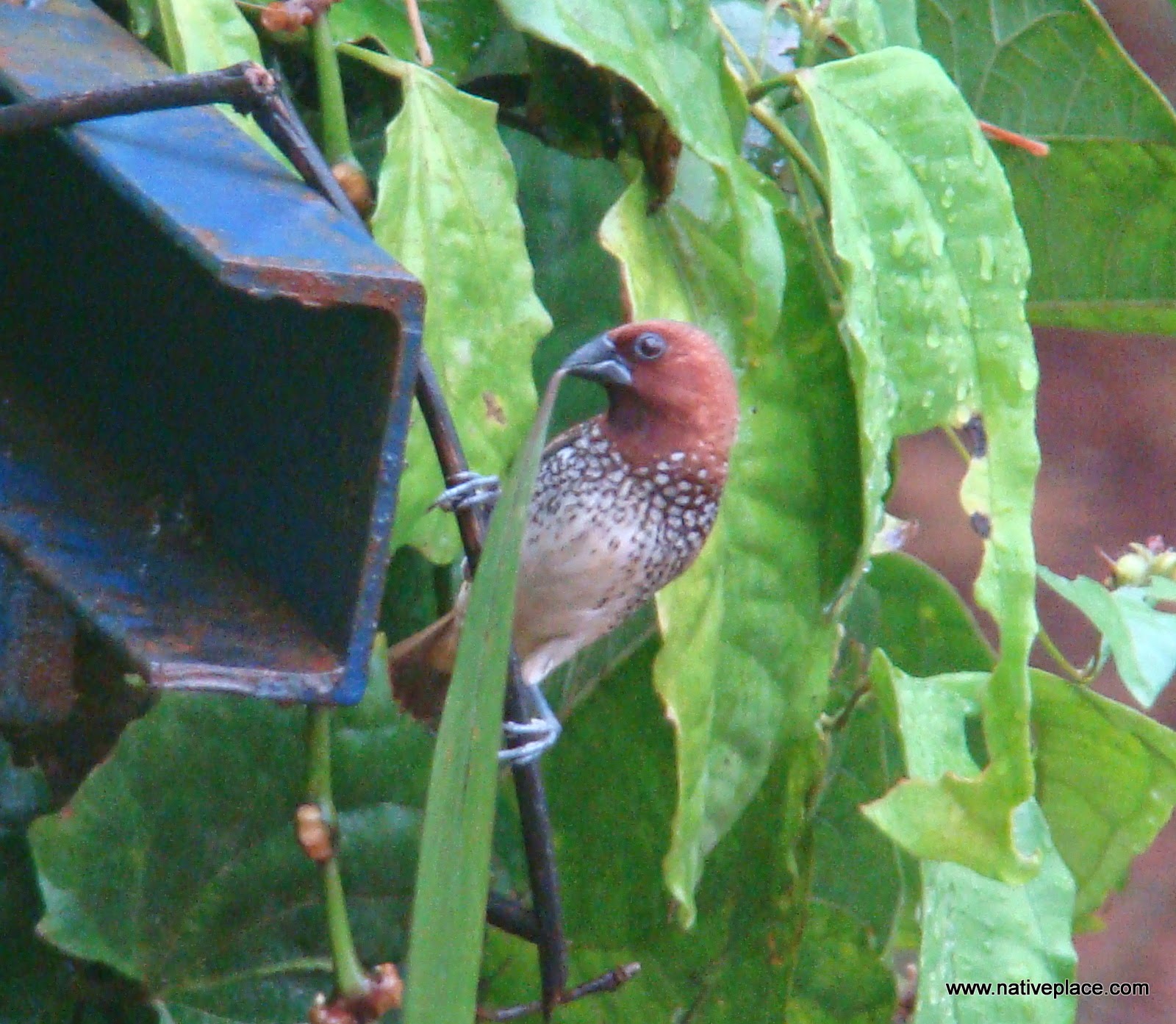
Last weekend I spotted a Scaly Breasted Munia in the garden from the veranda outside my room at Native Place  – Have only seen these birds once a few monsoons ago and was thrilled to spot  them so close to the house.  They were busy building a nest in the pergola outside the lake front rooms – this was easy to deduce as the birds were flying in and out with long grasses in their beaks and disappearing into the climber cover 

Here is some info on this little bird - The Scaly-breasted Munias breed year round and may have multiple broods on a good year, up to 3-4 broods. The male brings nesting materials while the female builds, often from the inside. In some, the breeding nest is later used as a roosting nest.

The nest is an untidy globe made out of grass and bamboo leaves, with a side entrance.  The nests are not woven and material is simply pushed together. But the nests are well-made, robust and waterproof. The birds work tirelessly and the nest can become an enormous globe. Both parents incubate. The eggs hatch in about 2 weeks and the young are fed entirely vegetable matter, which is regurgitated by the parents. They fledge in 18-19 days. Juveniles often form their own flocks after leaving their parents, and wander about together.  

Astrid Rao 

Monday, August 4, 2014

Whew! The Vadivali Lake is full

Vadivali Lake  -  A view from the Native Place Guesthouse

The monsoon did not start so well this season. There was an air of concern at the Native Place guesthouse. All our staff and most people plant rice and the delayed rain was definitely a problem.

With the signal of the first rains most people had planted out their paddy seeds (they usually save up seed from the last harvest to use the next season) now with the rain playing truant the sun scorched the young paddy seedlings. People had to bear the expense of buying seed and replanting.

Water level on the  21st July

The next question was would there be enough rain to fill up the lake. Our gaze turned to the lake in front of us and the brown banks all around it.  Each time we visited the guesthouse I took pictures from my balcony to monitor the levels of the lake.

Imperceptible change in level on the 27th  July 2014

Last week we drove up to Native Place on Wednesday evening. It was dark when we got there but the next morning (Thursday) I woke up excitedly and stepped out into the balcony camera in hand hoping for a steep increase in levels and there it was – yeaaaaaaaaaaaaah the lake is full. The paddy is thriving in the fields and all is well in our world.

3rd August 2014 - Full to the brim 

The rains played truant in the month of June but thankfully made up in the July.   

Astrid Rao 


Wednesday, July 16, 2014

Kingfisher Tales


Two weeks ago we drove up to Native Place early in the morning. We got there in good time and as usual I ran into the garden to see how it was getting along.   There had been a few drizzles and everything was green ad growing vigorously in the humid weather. The gardeners Anil and Eknath were quietly working on the slope above the veggie patch and I made my way towards them.  As I walked towards them I was greeted by an incessant scolding sound that seemed to be coming from high up in the trees. I spotted the familiar flash of blue immediately. ‘Now what’s her problem’? I thought. 


Then last week Anil showed me these tunnels bored into an unsightly bank of land that had been the result of overenthusiastic leveling of the slope to plant veggies last year. Big blunder it was and I cringed each time I laid my eyes on it praying for inspiration to help me disguise it.  Anil told me he had seen a kingfisher entering the tunnel and  beckoned me closer to listen to the sounds the chicks were making – I could see the scat at the entrance of the tunnel and as I leant forward. Once more on cue the kingfisher began to scold me for daring to go to close to the tunnel and I retreated not wanting to cause the poor mama any undue worry.

Kingfisher nest - Dont miss the white scat!

And then the penny dropped. Ah yes had read about this somewhere a while ago. Kingfishers make tunnels high on the mud banks of the river. They dig out the soft mud and lay their eggs there. Now this was by no means the lake or river bank but it did serve the kingfisher’s purpose.  Clever birds!!! They had found a suitable nesting place not even a hundred meters from the lake.  We were all delighted – to host the family of kingfishers but as far as mama bird was concerned she was not at all happy to have us lurking around. Hopefully she will get used to having us around – after all we do have vegetable plants to take care of. Until then we will have to tread lightly and put up with her rude calls. 

Saturday, April 5, 2014

Back Home at Native Place


Dwane sends me proof that the Palash is in flower :) 
Last week I visited Native Place for the weekend after a very long time.  In fact I had last been there during the Diwali holidays in November. My son’s exams had kept me busy in city and now finally I was able to get to Native Place. 4 long months of being away and yet once I was there it was like I had never left. Of course I had missed out on the flowering of the Palash and the Red Silk Cotton tree. I had missed many a harvest of vegetables from the garden and the birds too seemed to have gone away for the summer.

On Saturday morning I woke up and went into the balcony to see and hear a bunch of about 40 Bulbuls fooling about in the trees – there was a constant movement within the canopy of the Umbar, Jamun  and the Mahua trees as pairs chasing each other from one tree or branch to another – what a glorious site it was to see these birds at play.
Blue Flycatcher in the Naive Place Garden
It struck me then that Bulbuls was all I had seen – where had the ioras gone to I wondered – not many sunbirds to be seen either and as I thought these thoughts I spotted a flycatcher yes a Blue Flycatcher right there on the Umbar tree – a beautiful sight it was and made me very happy.

Then later Eknath the gardener showed me a Bulbul sitting in its nest – wonder if there will be chicks in the nest when I go up next. I showed it to Saumya – Vrinda and Chetan’s little girl and she was thrilled. Oh! The simple pleasures that fill the heart.

T
Another treat in the garden was the Petrea Volubilis in flower. -  such a graceful climber - here is a picture taken from my balcony

And now to look forward to a glorious summer with lots of paragliding, bird watching,  gardening and perfecting the art of sitting in a hammock and doing nothing 

 Peace Bliss and Happy Landings 

Astrid Rao