Pages

Showing posts with label weekend break from Mumbai. Show all posts

Wednesday, June 15, 2016

Cormorants Galore!

Last week at Native Place i happened to go up to the terrace after breakfast and was rewarded by the sighting of a huge flock of cormorants hunting for fish. A whole swarm of them were encircling an area presumably there were lots of fish there. From the distance they made a magnificent sight – the surface of the water was disturbed with their flapping wings as they swirled around creating a huge circular cauldron, diving in, running on water and flapping about. A few straggler egrets added to the drama creating a black and white canvas against the blue waters.  


I checked out this new phenomenon that seemed to be unfolding right in front of us for the next few days just to be sure and yes – it was happening every day. Wow!!!  Such a wondrous sight!

For the first time one can see what seems to be the entire colony fishing together and it makes quite an impact on the senses.

Cormorants have been a common sight by the lake shore at Native Place. Through the year one could spot the odd group in the mornings by the lake shore, diving for fish and perching on tree tops and bushes by the shores wings spread out to dry in the sun.  During summer evenings one had these exhilarating sightings where one looked up by chance to suddenly spot wave upon wave of V shaped flocks akin to migrating geese as they flew back to their roosting spots for the night (or so i believed)
In the recent years an entire colony has  taken to roost in a grove of acacia trees on a narrow spit of land that juts out into the lake  just a few years ago becoming our neighbors. J

Since then we have had the pleasure of watching them at sunset time as they circle around the area and then head for a tree. Lots of squawking and shoving goes on at sunset until they go quiet for the night.

It’s lovely to have a pristine water body before you and spot lake shore birds but to see an entire colony intently at work circling low over the lake is surely special!

The pictures above simply don't convey the largeness of the phenomenon - you have to see it to feel it ! Come connect with nature at Native Place.

More about Cormorants: - Cormorants are large black, fish eating birds with a long,  hook tipped bill.They  are daytime feeders that hunt alone or in flocks.  Cormorants feed by diving and swimming underwater. They can dive to depths of 5 to 60 feet below the surface and stay under water up to 70 seconds. They eat mostly fish and sometimes small invertebrates. Cormorants use their webbed feet to propel them underwater. Cormorants run along the surface of the water to gain enough speed for flight.  Watching these diving birds by the lakeside is a wonderful way to spend time.

Connections: - Recently i came across an interesting piece of info relating the presence of cormorants to tarpon fishing -
When you eat like a cormorant — which is a lot — you poop like a cormorant — which, again, is a lot. This potent concoction falls from the cormorant's precarious perch, entering the food chain only a few feet below. Bacteria then grow in this enriched, (let's call it fertilized) water. Soon the plankton count their lucky stars while feeding on this heaven-sent bounty. Small invertebrates and protozoa’s gorge on the plankton, and on and on it goes up the line. Shrimp, crabs and sardines bless father cormorant before gorging on the millions of minute krill or the collected organic detritus they leave behind.

At the top of this food chain are the tarpon. They come for the bounty the cormorant droppings provide and, with the tarpon, come the anglers. It is simple math: more cormorants mean more food for the tarpon's prey. More guano creates more food and more food means more tarpon.  
Perhaps we shouldn't be so judgmental about cormorants and their greedy eating and pooping habits. Perhaps we should be glad these ancient avians do their digesting where they do. Perhaps we should be glad they haven't better mastered the air. Perhaps we should be pleased they only use flight to get to the fishing grounds and then trundle home again, straight for the mangroves.
Some guides in Mexico say that they kill cormorants because they eat baby tarpon. Gentlemen … haven't you learned by now that it is best not to mess with Mother Nature? Let her be. She has things pretty well worked out, and her devices usually work to the benefit of the angler. Mess with her, and you just may be killing the goose that laid the golden egg. Although in this case it may not be a goose, but a cormorant, and it may not be an egg, but a pile of … OK, OK.  You get the picture. So let's all bless the cormorants.
 Astrid Rao 

Monday, June 13, 2016

Announcing the arrival of the Malabar whistling Thrush in the Native Place Garden


Folks – they have arrived!  We spotted a pair last week scouting around the Nirvana Cottage Wing for a nesting space. Heard the predawn song a few days ago a sweet whistling and had an easy spotting soon after. Watched the pair happily at work – seems like they too are happy to be back (they have been nesting here for a few years now) We will now have the pleasure of watching them as they select a nesting spot and build their nest, bring new chicks into he world and then work hard together to feed the young chicks who have voracious appetites.
Ah – so looking forward to this ! J
Also known as the ‘Whistling Schoolboy’ for the whistling calls that they make at dawn  - a slow soft mellifluous call with a sense of aimlessness about it.  Sounds like a carefree schoolboy whistling to himself as he strolls along.
The species is said to be resident in the Western Ghats although it visits the Native Place Garden to breed and raise its young.  I have read that they can be spotted near rocky streams and in riverine habitats either in the shady undergrowth or in a really difficult to spot location and are usually most active at early dawn or dusk making them difficult to photograph

This large thrush appears blackish with shiny patches of blue on the forehead and shoulders. It is omnivorous, eating a wide range of insects. crabs, frogs, earthworms and berries.


Which Kadamba Tree ?

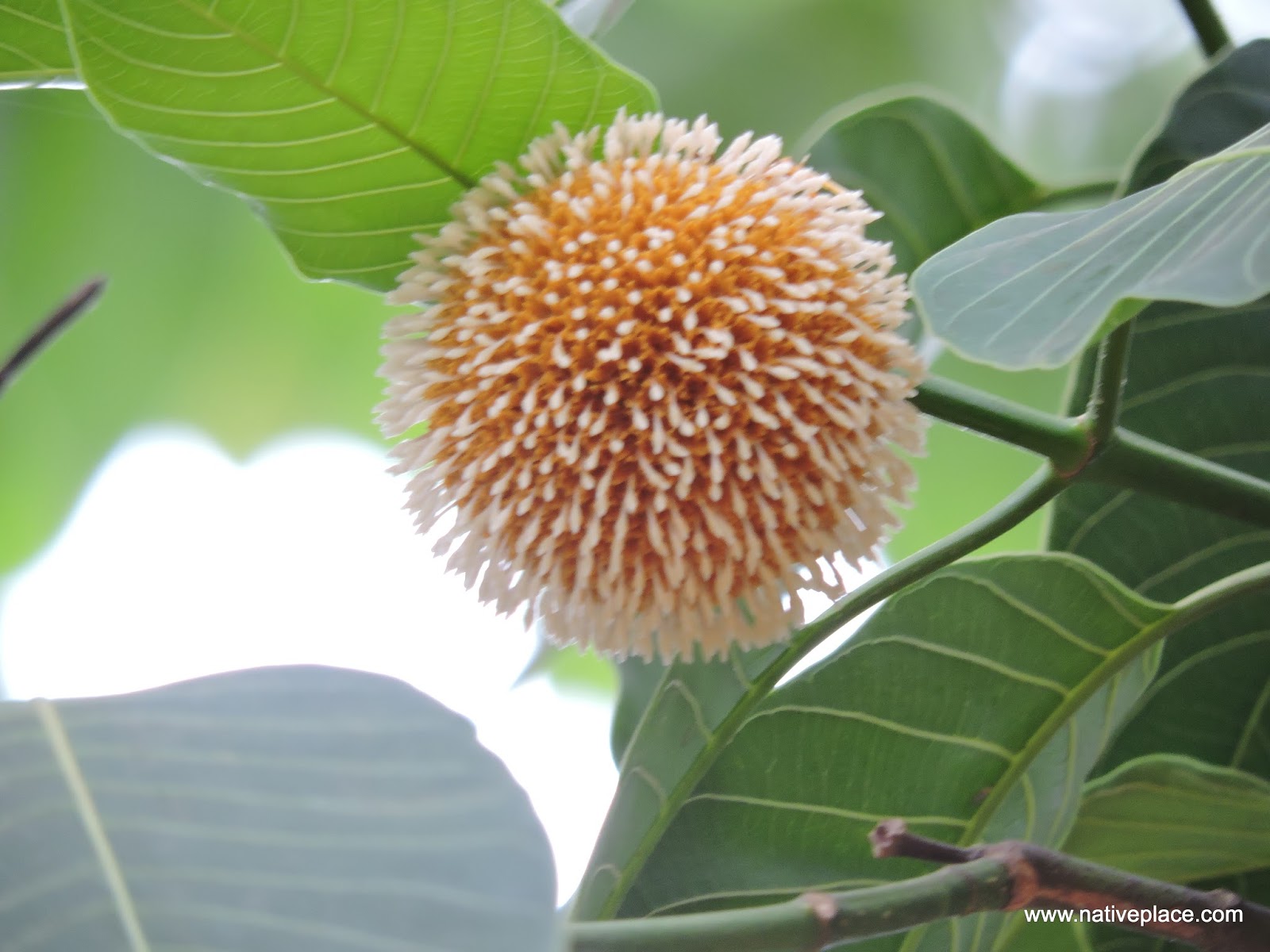
Kadamb (Anthocephalus Cadamba/कदंब) or The Common Bur Flower is a large, handsome, umbrella shaped tree with branches arranged in whorls around the central trunk. It is evergreen, fast growing and has a graceful appearance.  It produces unique globular shaped flowers coloured a striking yellow to orange.  
 In India the tree is mainly associated with Lord Krishna and stories about him and his gopis prancing about in the forests of Brindavan among the Kadamba groves abound.  This tree is also closely associated with the Mother Goddess (often referred as Kadambavana vasini) "She Who Resides in the Forest of Kadamba Trees."

We have a lovely specimen of this legendary tree in the Native Place Garden that we planted about 7 or 8 years ago having been intrigued by the lore of its beauty as well as its mythological and ecological associations.  You can enjoy its beauty and shade throughout the year but in the month of May the tree offers a special sensory experience when it flowers in profusion, showing off its quaint yet beautiful flowers that attract a host of bees and exude a heady perfume. And as the flowers drop one finds the curious golden globes scattered all around the tree waiting to dry off and release thousands of little seeds.

We have built a low wall all around our Kadamba tree. A silent invitation to you to come sit under this tree and enjoy the ambience it conjures.

The Kadamba Anthocephalus Cadamba  is often mixed up with the Kaim – Mitragaayne parviflora  a tree that is dominant in the forests of Brindavan. Both spcies produce globular blossoms but the Kaim’s flowers are not as striking  to look at. They also differ greatly in canopy and leaf shape. Where the Kadamba has a straight bole and branches arranged in upward reaching whorls the Kaim has a fairly meandering trunk.

i came across the Kaim in the “Trees of Delhi” by Pradeep Kishen. Pradeep  sheds light on this confusion/ puzzle on page 149 –  where he informs us that the REAL Krishna Kadamb  of Brindavan is Neelamarcia  cadamba ‘Kaim’ not Anthocephalus Cadamba ‘Kadamba’  which  is unique to moist  forests in the NE of  India and would not survive unaided in the hot dry  Brindavan area.  Kaim on the other hand is not only native to the remnant Brindavan forests but is their dominant tree. But in the Brindavan region the Kaim is called kadamb  J  no wonder the confusion !

Oh well !!! Our Kadamba may not bring to mind the visual of Krishna playing his flute any more but it remains the tree closely associated with the Mother Goddess  - Kadambavana vasini "She Who Resides in the grove of Kadamba Trees."
The tree is said to be vanishing from Indian forests and needs to be planted and celebrated once more for it its beauty, functionality and usefulness.
Some Uses
This beautiful tree is also known for its medicinal virtues. The tree has astringent & antipyretic properties. It is believed to have cure for ulcers, digestive ailments, diarrhoea, expectorant, fever, vomiting etc.

A yellow dye is obtained from the root bark. Kadamb flowers are an important raw material in the production of attar, Indian perfume with Sandalwood (Santalum Album). The tree is grown along avenues, roadsides and villages for shade. The fresh leaves are sometimes used as plates.


In Permaculture
The Kadamba is suitable for reforestation programs. It sheds large amounts of leaf and non-leaf litter which on decomposition improves  the  physical and chemical properties of soil.

Cultural aspects
It is common belief among the natives of many villages in the state Chhattisgarh that plantation of Kadamb tree near to lakes and ponds, brings happiness and prosperity in their life.


Thursday, January 21, 2016

5 Star Bird Watching in the Native Place Garden

  
 Doc was here on his annual visit. He has been spending the month of December with us (Native Place & Nirvana Adventures) for almost a decade now to indulge in Paragliding his main obsession along with swimming, bird watching, gardening and this time cycling too.


This year things were a bit different. Doc said he had gotten over his paragliding obsession and although flying remains high on his list he often took time out now and then to indulge in the art of doing nothing.

One day i came across him sprawled in a hammock in a shady isolated spot in the garden. He had a book and his binoculars handy and when I approached him he mentioned to me that he was indulging in 5 Star bird-watching. It’s simply perfect he said – all afternoon I relax here reading and every now and then a bird comes by and as I sit here watching the birds present themselves and I don’t even have to move to see them from different angles to recognize or admire them.

Doc has been a birder for many years and i often go to him if I am not able to recognize a new visitor. We discussed the variety of birds that visit the garden – thanks to the biodiversity that we have created over the past years. Birds are indicators and their presence tells us that we have done a good job.

Check out the album of just some of them that we have clicked over the years.
Happy Birding and Hammocking in the Native Place Garden


Astrid Rao 


www.flynirvana.com

Monday, August 4, 2014

Whew! The Vadivali Lake is full

Vadivali Lake  -  A view from the Native Place Guesthouse

The monsoon did not start so well this season. There was an air of concern at the Native Place guesthouse. All our staff and most people plant rice and the delayed rain was definitely a problem.

With the signal of the first rains most people had planted out their paddy seeds (they usually save up seed from the last harvest to use the next season) now with the rain playing truant the sun scorched the young paddy seedlings. People had to bear the expense of buying seed and replanting.

Water level on the  21st July

The next question was would there be enough rain to fill up the lake. Our gaze turned to the lake in front of us and the brown banks all around it.  Each time we visited the guesthouse I took pictures from my balcony to monitor the levels of the lake.

Imperceptible change in level on the 27th  July 2014

Last week we drove up to Native Place on Wednesday evening. It was dark when we got there but the next morning (Thursday) I woke up excitedly and stepped out into the balcony camera in hand hoping for a steep increase in levels and there it was – yeaaaaaaaaaaaaah the lake is full. The paddy is thriving in the fields and all is well in our world.

3rd August 2014 - Full to the brim 

The rains played truant in the month of June but thankfully made up in the July.   

Astrid Rao 


Wednesday, July 16, 2014

Kingfisher Tales


Two weeks ago we drove up to Native Place early in the morning. We got there in good time and as usual I ran into the garden to see how it was getting along.   There had been a few drizzles and everything was green ad growing vigorously in the humid weather. The gardeners Anil and Eknath were quietly working on the slope above the veggie patch and I made my way towards them.  As I walked towards them I was greeted by an incessant scolding sound that seemed to be coming from high up in the trees. I spotted the familiar flash of blue immediately. ‘Now what’s her problem’? I thought. 


Then last week Anil showed me these tunnels bored into an unsightly bank of land that had been the result of overenthusiastic leveling of the slope to plant veggies last year. Big blunder it was and I cringed each time I laid my eyes on it praying for inspiration to help me disguise it.  Anil told me he had seen a kingfisher entering the tunnel and  beckoned me closer to listen to the sounds the chicks were making – I could see the scat at the entrance of the tunnel and as I leant forward. Once more on cue the kingfisher began to scold me for daring to go to close to the tunnel and I retreated not wanting to cause the poor mama any undue worry.

Kingfisher nest - Dont miss the white scat!

And then the penny dropped. Ah yes had read about this somewhere a while ago. Kingfishers make tunnels high on the mud banks of the river. They dig out the soft mud and lay their eggs there. Now this was by no means the lake or river bank but it did serve the kingfisher’s purpose.  Clever birds!!! They had found a suitable nesting place not even a hundred meters from the lake.  We were all delighted – to host the family of kingfishers but as far as mama bird was concerned she was not at all happy to have us lurking around. Hopefully she will get used to having us around – after all we do have vegetable plants to take care of. Until then we will have to tread lightly and put up with her rude calls. 

Friday, April 11, 2014

Native Place Summer Holidays


Bird excitement continues at the NP guesthouse – the Sunbird who built its nest in trellis framing the lake view gallery, a high traffic zone of the guesthouse, protests loudly each time someone comes by to sit here and enjoy the view. Her chicks have now hatched and she makes frequent trips to feed them.

A pair of sparrows has decided to build its nest above the fuse box in the entrance landing. Their swooping sorties past the sunbirds nest and over all our heads adds to the excitement.  The area has turned into a veritable flying corridor. They have taken to harvesting hay and other building material from another birds nest to speed up their building operation much to the consternation of mama Sunbird. We often hear them squawk as they race each other to the nest building site. They seem to be fooling around like a pair of young lovers running wild on the beach.

And yes the Bulbul's eggs I mentioned in my previous blog have hatched. We got here in time to watch the parents feed the babies for a day before bad weather or some other eventuality L caused the chicks to fall out of the nest. By the next day the parents moved them away and put paid to our ideas of watching them grow and learn how to fly.

The greatest excitement by far has been the daily visit of a pair of Grey Hornbills who appear each evening.  


Astrid Rao 

Sunday, February 5, 2012

One day Hornbills will visit my garden


Years ago I used to watch an animated tv series called the Wild Thornberries with my son Sunith.   A show about a little girl called Eliza Thornberry who travels the world with her famous nature show host parents and falls into exciting wildlife adventures.

On one such show the Thornberries were on an expedition somewhere in India hoping to film a species of a rare Hornbill. In the episode they were camped out in the forest clearing near some huge trees laden with wild fruit that the Hornbill loves to eat.

This episode stayed with me and when I first started planting trees at Native Place I looked for species that attracted birds. I had imagined the whole thing unfolding in front of my eyes. Planting the trees…watching them grow and bear fruit… the birds arriving to nest and feast on the fruit

Much later I got to know that the Hornbill’s loved to eat wild figs. This was amazing to me -  they loved the fruit of the one lone large specimen i.e. the Umbar tree that existed in Native Place garden. I quickly jumped to the happy conclusion that since we have an Umbar (wild fig) in the garden that fruits copiously we should be graced with Hornbills.  Rather simplistic thinking considering that these noisy, social, omnivorous birds need large tropical forest areas with many fruiting trees throughout the year to survive. But there were forests in the hills around and so I continued to have hope. A couple of years ago we spotted our first pair of Hornbills in the garden and soon they became a regular sighting in the Native Place garden.

I put a picture up a few weeks ago on facebook and Anand Pendharkar congratulated us as the Indian Grey Hornbill (Ocyceros birostris) is an indicator of intact forests and deserves conservation attention.

We are so grateful for our beautiful Umbar tree  and all the denizens in the garden that it supports and nurtures.

Shine on Umbar tree!

Peace Bliss & Happy Landings

Astrid Rao
www.nativeplace.com
www.flynirvana.com

Wednesday, October 5, 2011

Small Minivet in the Native Place Garden


Hi All,

For the last few weekends we have been noticing this elusive brightly colored bird flitting about in the tops of the Umbar tree but have been unable to identify it or capture it on camera. We have been spotting them in pairs or more in the late afternoon, flitting about and then moving on.  They were easy to spot because of their bright colors yet not so easy to capture because of their restless habits. But finally we got lucky last weekend.

We were able to identify it after taking the above picture. The weather was dull and the picture is not sharp but it was enough for us to identify it.

The Small Minivet is said to be a widespread resident in our area and prefers open wooded areas. Has it started to visit the Native Place garden recently or is it that we have never noticed them before. Whatever may be the case – Welcome Small Minivet.

Astrid Rao

Friday, April 11, 2008


The beautiful red lilies and their pink and white relatives have been flowering profusely for the past two weeks. Then last week this beautiful salmon pink lily flowered for the first time and what a beautiful sight it made. On browsing through a book I found that Hippeastrum (Red Lily) is its name of these bulbous plants with narrow strap-shaped leaves and that two other kinds, one having salmon-colored flowers and the other having white petals with pink veins are also commonly grown. All kinds flower at least once a year and even a short period of dry weather seems to stimulate growth. So I guess the acute water shortage we are facing has an upside after-all with all 3 colors represented in the garden.

Astrid Rao