The
Native Place guesthouse and garden is a labor of love that we have tended to since early 2000. Today the garden comprises a delightfully diverse group of flora and fauna. a paradise for tree lovers and birders and everyone who loves nature and gardening. It is exactly what we had envisioned it to be and more but being just an acre and a half in area we soon ran out of place to accommodate the plant palette (our wish list of trees). Palikade, (an 18-acre plot of land in Thoran Village) that we acquired for this express purpose, is where we intend to manifest this dream. The vision is to develop Palikade as a self-sustaining farm & tropical food forest aimed at facilitating harmony amongst all stakeholders in the habitat (the birds, insects, microorganisms and other animals as well as us humans).
We were aware that it was very important to work on Water Harvesting & Soil Conservation (WH & SC) structures as a priority before planting trees on a large scale. These are also called ‘landforms’. The land at ‘Palikade’ comprises two fairly flat areas of land divided by a huge gully running in between. The slopes and high rainfall combination in this region meant that significant soil and water was running off the land every monsoon. Also, rain is the only source of water on this land, so, the sooner we undertook the work on landforms, the lesser would be the loss of precious soil and greater the gains of water retention.
The Permaculture Design Course (PDC) that we attended in March 2016 gave us significant confidence with respect to the understanding of WH & SC. We undertook practical work at the PDC, designing and creating WH & SC structures like contour trenches, percolation tank, gully plugs and brushwood. Our two gardeners at Native Place, Anil & Eknath, attended two days of Water Harvesting sessions at the PDC and thankfully they too learnt the basics and were able to support us in this effort.
Our journey of implementation started with
inviting Narsanna to Palikade when he gave us some crucial inputs regarding WH
& SC work. Thereafter, we invited Osman Baig, a watershed expert who we met
during the PDC, to guide us with the location for different WH & SC structures.
Osmanji, came in April for two days and helped us mark the area for a
percolation tank, a pond, trenches & bunds and some gully plugs. We asked
him plenty of questions so that we understood the logic of all his inputs.
Thereafter, we got down to detailed marking
of all the structures on the land. We then did rough measurements around the
entire land & drew out the plan and designs on paper. This helped us get
greater clarity of the overall picture. The next step was actually making these
structures with the help of a JCB and manual labor.
We also figured the details from local
sources that annual rainfall in this area was about 2,500mm, number of rainy
days was 82 and the highest rainfall in 24 hours was 176 mm. This helped us
decide factors like the depth of the trenches to be dug and the distance at
which contour trenches needed to be dug.
Some details about the structures are
provided along with the individual pictures in this album. Need to specially
mention here about the Percolation tank (PT) and pond. Part of this property
(about 1 acre) is on the other side of a road, towards the South. It has high
slope. At the bottom of this sub-plot, there is the possibility of accumulating
water from a catchment of about 7 hectares. Hence a PT was created right there.
The water that is likely to accumulate there is being routed to another pond on
the farm, through a pipe running across & under the road.
On his subsequent visit, Osmanji also
identified the scope to route more water to the pond by creating a rainwater
diversion trench. He also suggested developing a micro-pond in the Western side
of the plot – this area was quite rocky and was sloping towards a small gully,
which further met the main gully.
By end of May, we had completed all the
landforms work. The structures we created have the capacity of holding about 34
lac liters of water at one time.
Structures
|
Capacity
- Volume
|
About 1,200 running metres of deep
trenches and bunds
|
1200 m3
|
12 lac litres
|
Percolation tank
|
350 m3
|
3.5 lac litres
|
Pond
|
1700 m3
|
17 lac litres
|
Micro pond
|
100 m3
|
1 lac litres
|
Staggered trench
|
14 m3
|
14,000 litres
|
Capacity / Volume(approx.)
|
3,407m3
|
33.64 lac litres
|
Simultaneously, in April & May, we were
working on designing the plantation on these WH & SC structures, collecting
seeds directly from trees & from friends & networks, growing saplings
in our own nursery at the Native Place guesthouse & also scouting nurseries
for plants that we were not growing ourselves. By second week of June, we were
all equipped to start planting - the story of which you may have read in our
previous post regarding the plantation J
This has been the first phase of WH &
SC and plantation. We intend to take this forward step by step and attempt more
intricate permaculture applications. The aim is to conserve & impound
rainwater, raise aquifer levels, enhance soil health, create micro climates and
an abundant habitat!
We’ve never felt we had completed anything
very significant until now. But the amount of inquiries we received from our
farmer friends for a detailed account of the work pushed us to do this write
up. Feeling humbled & grateful.
In Solidarity,

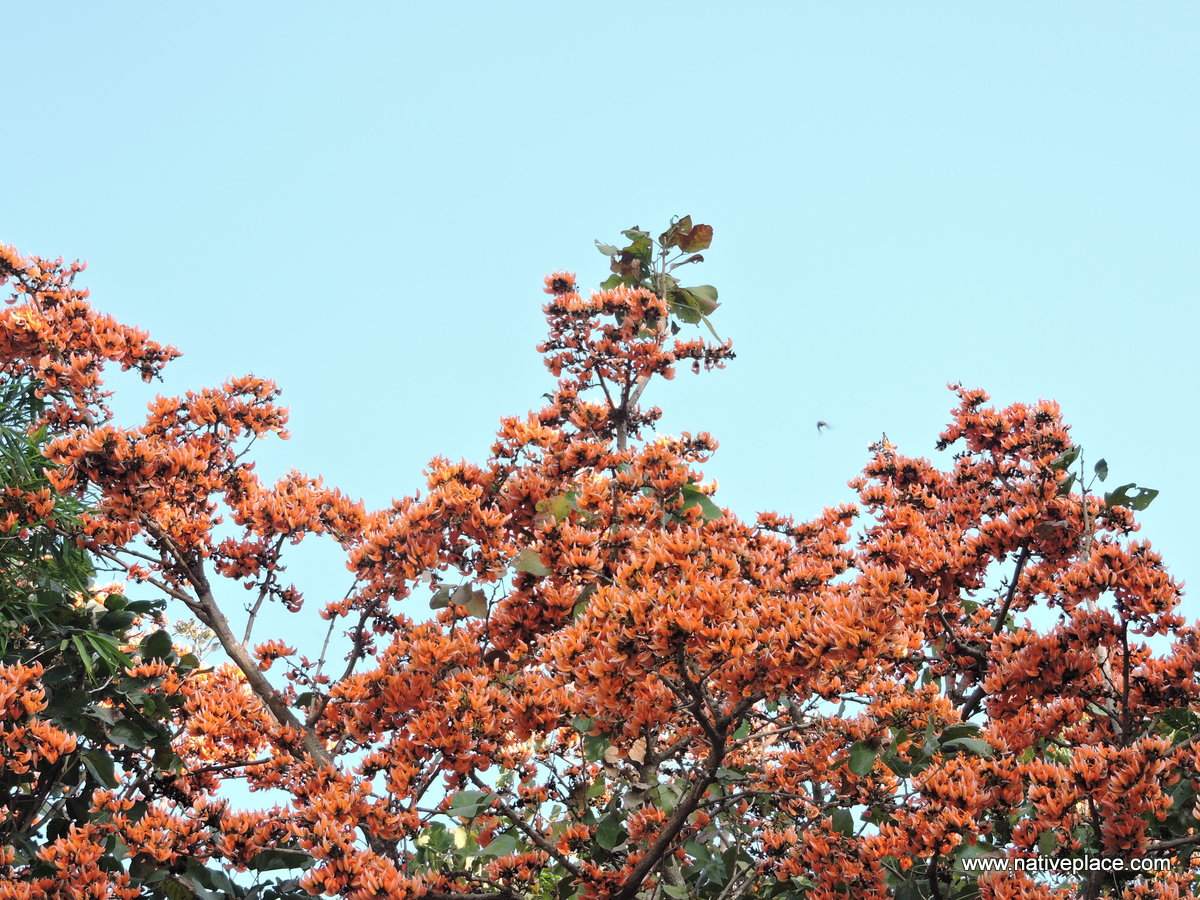
 Each day the flowers drop onto the steps that lead to the
main door adorning them as though someone has painstakingly strewn flowers to welcome the Native Place Guesthouse visitors and Nirvana Paragliding students. .
Each day the flowers drop onto the steps that lead to the
main door adorning them as though someone has painstakingly strewn flowers to welcome the Native Place Guesthouse visitors and Nirvana Paragliding students. . 


