Pages

Showing posts with label fragrant plants. Show all posts

Monday, January 16, 2017

The Palash Tree Cafe at Native Place is now open

This year our  Palash tree has flowered in January – a curious thing because it usually flowers in March. Another significant thing for us is that it has flowered vigorously – the whole canopy is aflame with its blossoms making a striking picture. Is our late bloomer making up for its tardiness or is this also a result of global warming - one just isn't sure. 
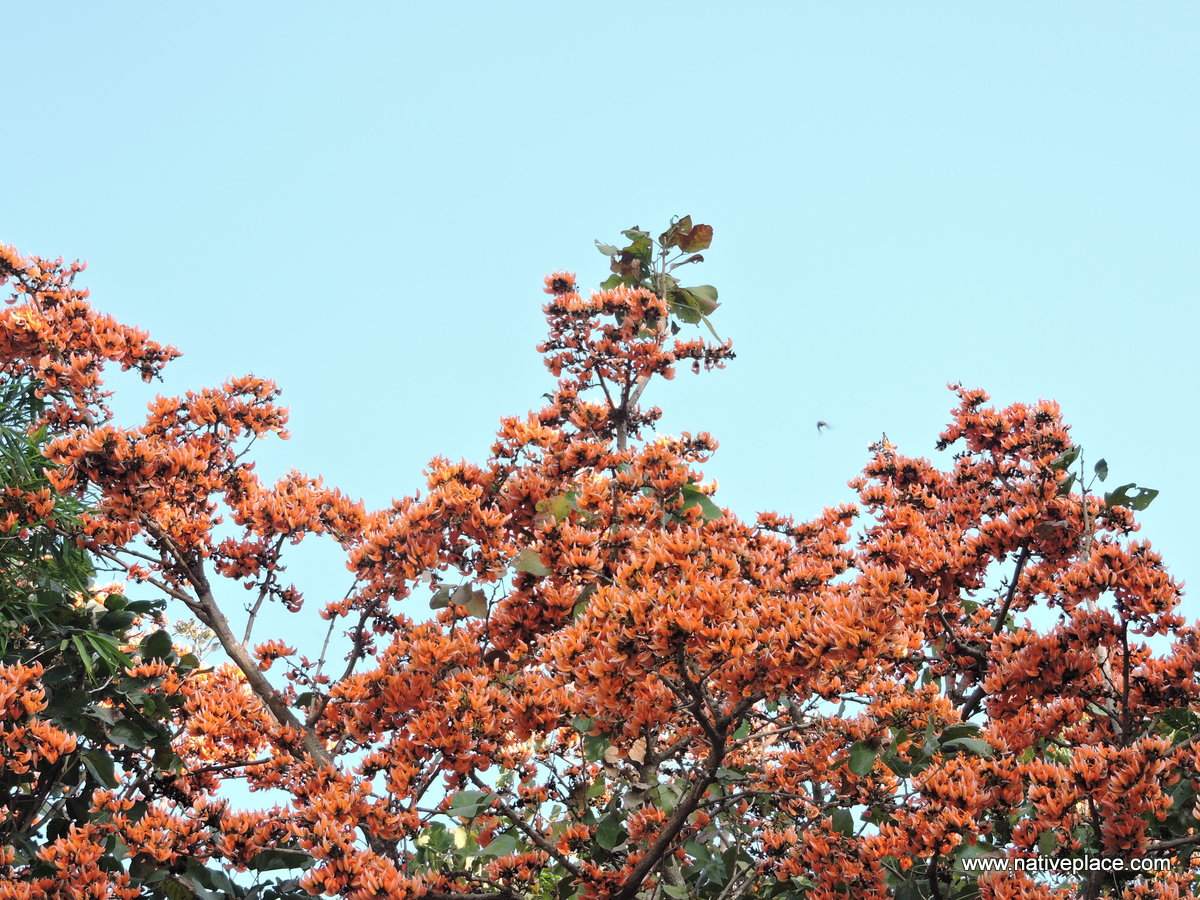
Each day the flowers drop onto the steps that lead to the main door adorning them as though someone has painstakingly strewn flowers to welcome the Native Place  Guesthouse visitors  and Nirvana Paragliding students. . 
I went up to the terrace to get a better view and spotted a number of birds and squirrels attracted by the nectar full flowers. As i sat there i also smelt the Madhu Malati flowers and realized that the fragrance is quite strong in the early mornings.
Pasaba has started to use them in her floral urali decorations 
Coming back to the Palash tree – we are collecting the flowers to make a holi color – again this year. Did you know that the flowers were used to dye monks’ robes?  The flowers can also be  used to make a drink a herbal tea that helps one beat the heat.
For the next few weeks the terrace is going to be my morning go to place .  It is delightful to watch the soft early morning sun’s rays turn the canopy into a fiery orange thereby signalling the birds that the cafe is open. Cause soon after this the birds and squirrels arrive to feast on the sustaining morning beverage (nectar) their antics lead to the dropping of the flowers onto the steps. 
All this while i breathe in the crisp morning air scented by the beautiful flowers of the Madhu Malati vine 
Sheer bliss :) 
Astrid Rao 

Monday, June 13, 2016

Which Kadamba Tree ?

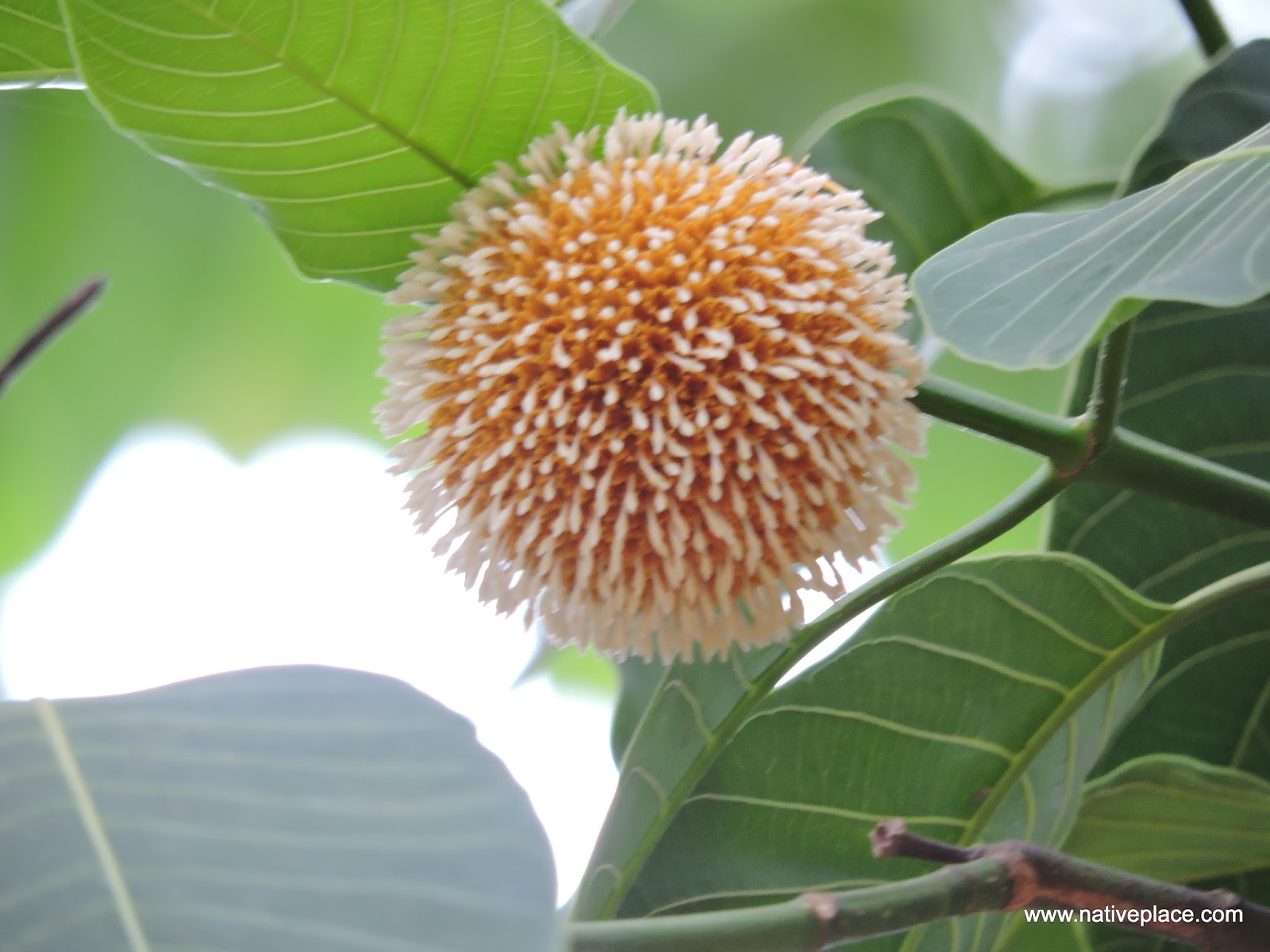
Kadamb (Anthocephalus Cadamba/कदंब) or The Common Bur Flower is a large, handsome, umbrella shaped tree with branches arranged in whorls around the central trunk. It is evergreen, fast growing and has a graceful appearance.  It produces unique globular shaped flowers coloured a striking yellow to orange.  
 In India the tree is mainly associated with Lord Krishna and stories about him and his gopis prancing about in the forests of Brindavan among the Kadamba groves abound.  This tree is also closely associated with the Mother Goddess (often referred as Kadambavana vasini) "She Who Resides in the Forest of Kadamba Trees."

We have a lovely specimen of this legendary tree in the Native Place Garden that we planted about 7 or 8 years ago having been intrigued by the lore of its beauty as well as its mythological and ecological associations.  You can enjoy its beauty and shade throughout the year but in the month of May the tree offers a special sensory experience when it flowers in profusion, showing off its quaint yet beautiful flowers that attract a host of bees and exude a heady perfume. And as the flowers drop one finds the curious golden globes scattered all around the tree waiting to dry off and release thousands of little seeds.

We have built a low wall all around our Kadamba tree. A silent invitation to you to come sit under this tree and enjoy the ambience it conjures.

The Kadamba Anthocephalus Cadamba  is often mixed up with the Kaim – Mitragaayne parviflora  a tree that is dominant in the forests of Brindavan. Both spcies produce globular blossoms but the Kaim’s flowers are not as striking  to look at. They also differ greatly in canopy and leaf shape. Where the Kadamba has a straight bole and branches arranged in upward reaching whorls the Kaim has a fairly meandering trunk.

i came across the Kaim in the “Trees of Delhi” by Pradeep Kishen. Pradeep  sheds light on this confusion/ puzzle on page 149 –  where he informs us that the REAL Krishna Kadamb  of Brindavan is Neelamarcia  cadamba ‘Kaim’ not Anthocephalus Cadamba ‘Kadamba’  which  is unique to moist  forests in the NE of  India and would not survive unaided in the hot dry  Brindavan area.  Kaim on the other hand is not only native to the remnant Brindavan forests but is their dominant tree. But in the Brindavan region the Kaim is called kadamb  J  no wonder the confusion !

Oh well !!! Our Kadamba may not bring to mind the visual of Krishna playing his flute any more but it remains the tree closely associated with the Mother Goddess  - Kadambavana vasini "She Who Resides in the grove of Kadamba Trees."
The tree is said to be vanishing from Indian forests and needs to be planted and celebrated once more for it its beauty, functionality and usefulness.
Some Uses
This beautiful tree is also known for its medicinal virtues. The tree has astringent & antipyretic properties. It is believed to have cure for ulcers, digestive ailments, diarrhoea, expectorant, fever, vomiting etc.

A yellow dye is obtained from the root bark. Kadamb flowers are an important raw material in the production of attar, Indian perfume with Sandalwood (Santalum Album). The tree is grown along avenues, roadsides and villages for shade. The fresh leaves are sometimes used as plates.


In Permaculture
The Kadamba is suitable for reforestation programs. It sheds large amounts of leaf and non-leaf litter which on decomposition improves  the  physical and chemical properties of soil.

Cultural aspects
It is common belief among the natives of many villages in the state Chhattisgarh that plantation of Kadamb tree near to lakes and ponds, brings happiness and prosperity in their life.


Tuesday, July 29, 2014

Pink & Purple


It is the monsoon season and the predominant color is green but pink purple and silver seemed to be the theme of the weekend – there were Michelle’s purple boots that were driving me insane – all I could think of was I want I want I want

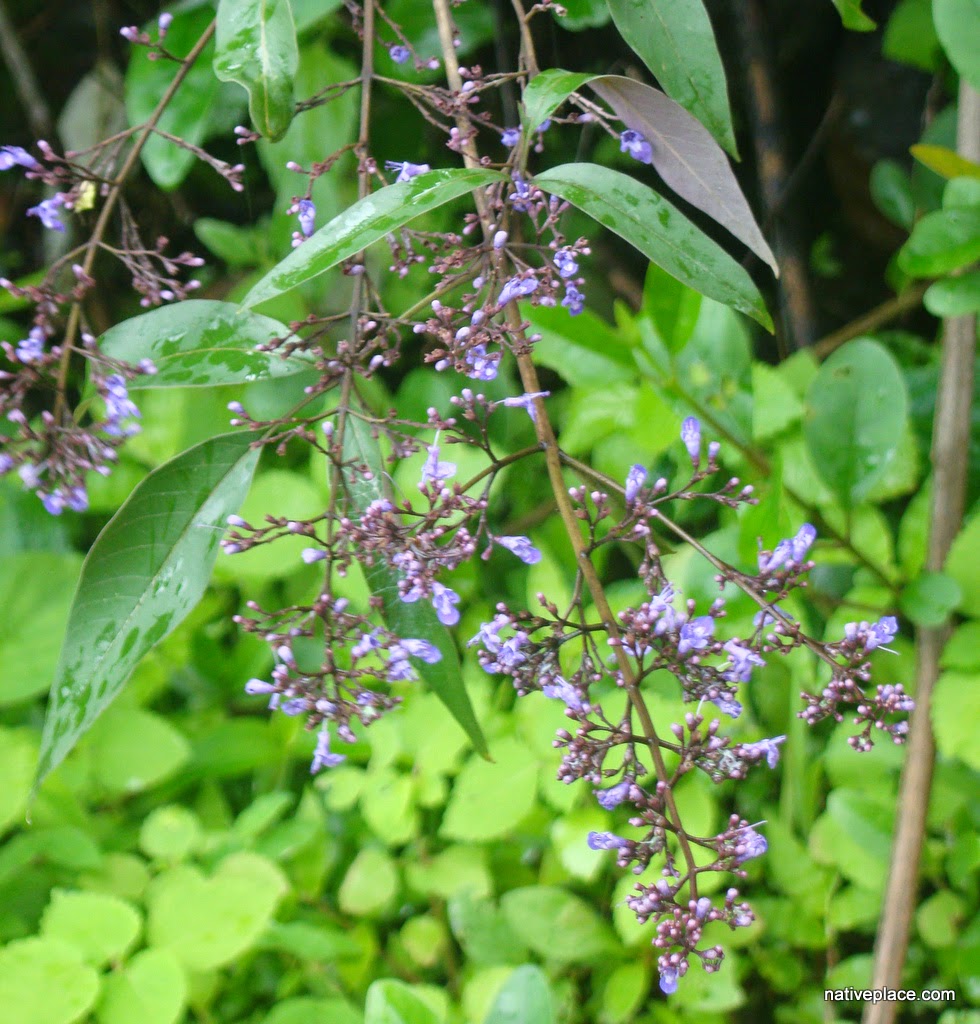
Then we noticed 2 varieties of Vitex Negudo in flower

and the pink frangipani that we had planted 2 years ago

The check dams we had built them in summer seem to be working like magic – tiny little silvery water falls

We came across a tree fall – check Dwane drinking this moss charged water

A medicinal plant in flower – one of the Dashamularisht that is supposed to be in short supply and may be endangered also pink (sorry I don’t know the name)


Green – the color of the paddy we have planted – next weekend is transplanting time so guys if you want to get your feet squishy in muck and plant the rice that we will serve you soon … come on over 


Come on over :)

Peace Bliss & Happy Landings 

Astrid & Sanjay Rao 

Monday, March 10, 2008

Brugmansia Surprise (Frosty Pink)


Last month while walking in the garden I noticed something curious. The little Lagerstroemia tree sapling that I had planted in June, adjacent to the low ropes course with the intention of enjoying beautiful flowers as well as shade in a few years had sprouted long green pods. Quite a mystery it seemed to present – what with the pods not sporting any Lagerstroemia type characteristics about them.

Within a few days the pods had opened to reveal delicate long handsome pendant pink flowers – a magnificent way to uncover a mistaken identity. It revealed itself to be the Brugmansia and not the Lagerstroemia sapling I had mistaken it for at the time of planting. Welcome Brugmansia!

I have read that for the night garden, Datura's and Brugmnsia's are a necessity. These beautiful fragrant plants, commonly known as Angel's Trumpet open up after dark and remain open until the sunlight hits them the next morning. The perfume that the flowers release is said to be extremely sweet and intoxicating and they are known to flower all year with proper care.

I have plans to build in a bench right below this shrub – where one can sit in the late evening, watch the buds open after sunset, enjoy their famed fragrance and admire the delicately beautiful flowers long before the sun’s rays cause them to wilt.

An Angle's Trumpet heavy with blossoms is a very impressive sight. I have seen a glorious white flowering specimen in Panchgani and my friend Shirish told me that he had seen loads of them growing in hedges alongside the roads in Mahabaleshwar.

Astrid Rao

Monday, November 19, 2007

The Queen Of The Night - Cestrum Nocturnum


Dag arrived from the land of the midnight sun and landed at Native Place on Wednesday in the early hours of the morning in time for Diwali the festival of lights. Only last weekend I noticed that the ‘Raat ki Rani’ or the Queen Of The Night was covered with buds – the bushes seem to have geared up to scent up the night with their amazing fragrance as if in time to welcome Dag back. He simply loves the fragrance!

We can look forward to heavenly scented Diwali nights minus the noise and air pollution and returning to native place each evening after long sunny day at the flying site to sit out on a cool stone platform and taking deep meditative breaths as the calming fragrance wafts through the air and envelopes us. Fairy lights will simply add to the atmosphere.


Astrid Rao